

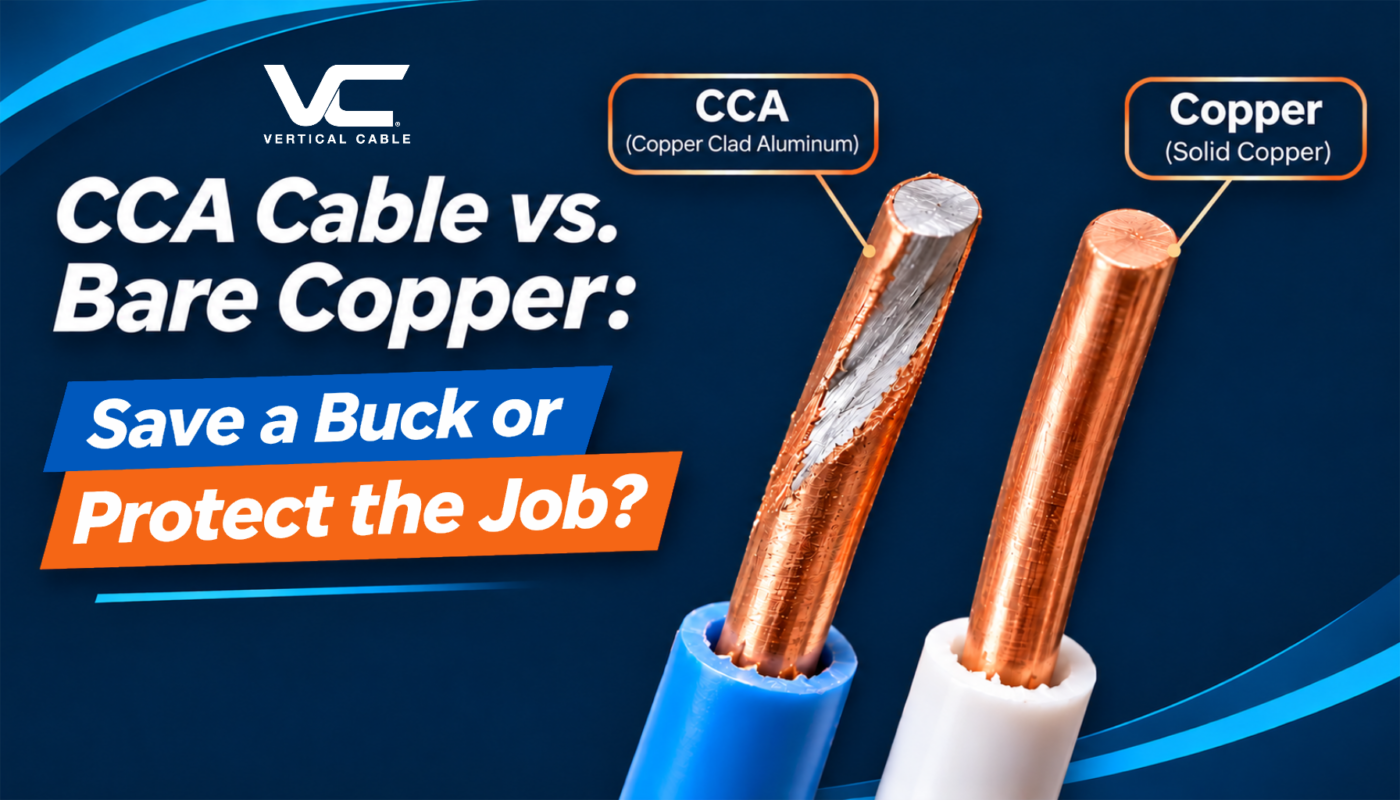
The cheapest box of cable is often the most expensive one on the job. It just doesn’t send the bill until later.
We hear this from integrators all the time. A customer, or sometimes a crew lead watching the budget, grabs a 1,000 ft box of “CAT6” from an online marketplace for a fraction of the usual price. It looks like CAT6, and the jacket even says CAT6. Then the PoE cameras start dropping, the certifier fails half the runs, or an inspector won’t sign off.
The real question isn’t how much you save on the box. It’s what you’re risking to save it: performance, code compliance, fire safety, and your reputation. Here’s how to tell CCA cable from solid copper, and what else to check before any cable goes into a wall.
What Is CCA Cable? Copper-Clad Aluminum vs. Bare Copper
Copper-clad aluminum (CCA) is an aluminum conductor with a thin copper layer bonded to its exterior. It can look identical to solid copper from the outside.
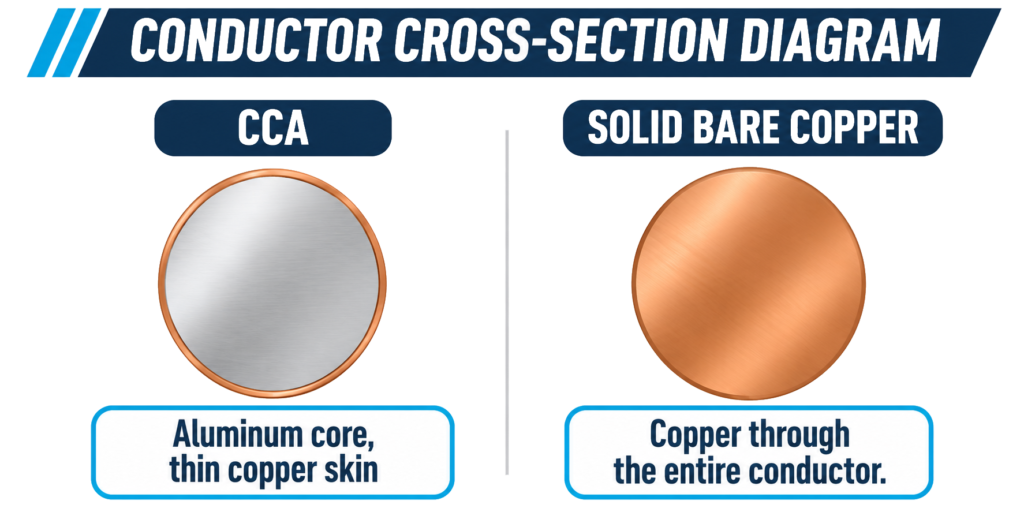
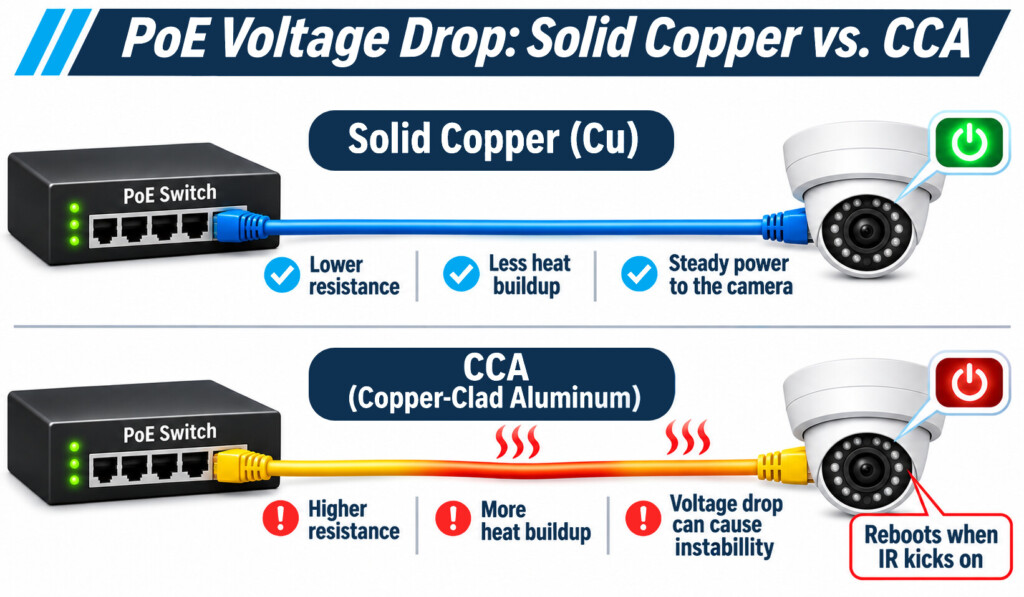
ANSI/TIA-568.2-D, the standard that defines Category cabling, requires solid or stranded copper conductors. That’s not a technicality. Aluminum behaves differently on the job:
|
The fix on site is simple: strip a conductor and scrape it with a knife. Silver under the copper means aluminum. Don’t trust box weight alone, because some vendors add ballast to the box.
Plenum vs. Riser Cable
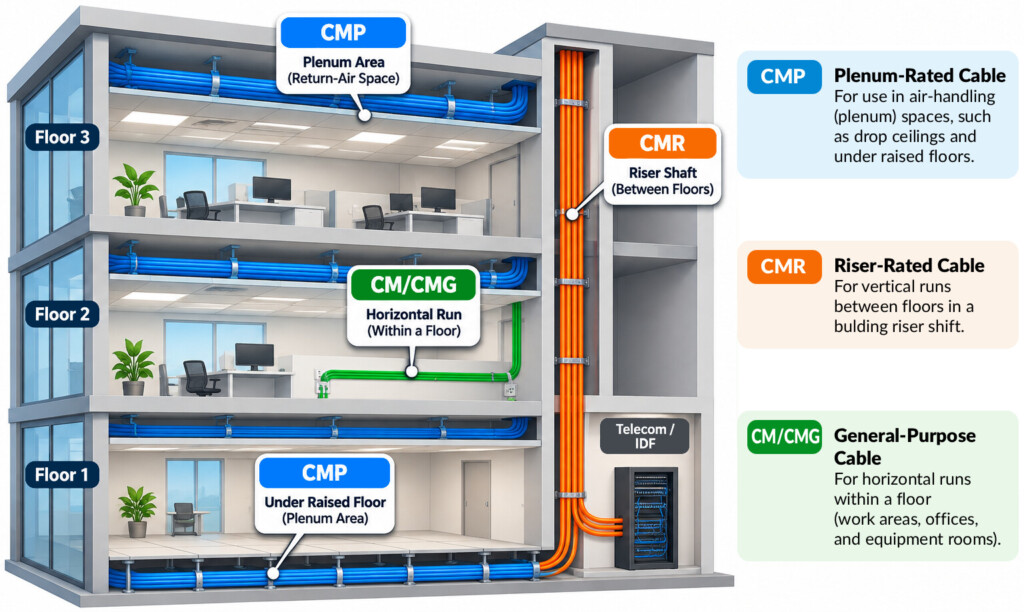
In the U.S., cable installed inside a building has to carry a fire-safety listing for where it goes. In the 2023 NEC, the listing requirements for plenum, riser, and general-purpose cable sit in Article 800. CCA can’t get a valid listing, so it can’t legally go where CM, CMR, or CMP cable is required.
Know the ratings you’re pulling:
Rating | Where It Goes |
|---|---|
CMP (PLENUM) | Air-handling spaces such as drop ceilings and raised floors used for return air |
CMR (RISER) | Vertical runs between floors |
CM / CMG | General-Purpose runs within a floor |
Understanding Cable Certifications
Two types of third-party certification are important, and they serve different purposes:
|
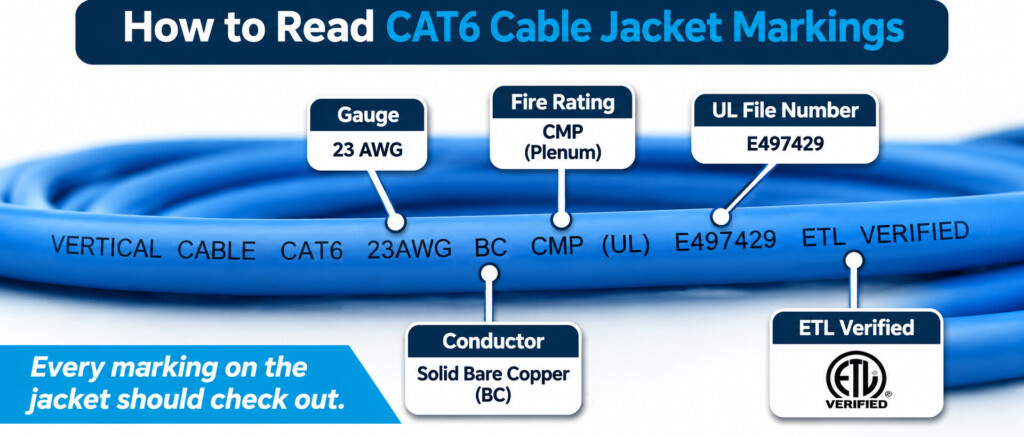
Don’t Rely On The Label Alone
Just because a cable box displays a UL or ETL certification mark doesn’t necessarily mean the product is certified. Counterfeit and unauthorized certification markings do exist.
In 2013, UL issued a warning about communications cable displaying certification information despite not having been evaluated by UL. The cable was also reported to lack required flame-retardant materials.
Always verify before you buy or install. Check the manufacturer’s certification and file number through UL Product iQ or Intertek’s ETL directory. For a convenient option, the free CCCA CableCheck app helps users verify UL file numbers and access ETL certification information.
What The Industry Says
This isn’t just a manufacturer’s opinion. The groups that write the standards and train the installers agree.
|
There’s also a testing catch. A basic field test may pass CCA on short runs. Fluke’s limited field data shows CCA failing DC resistance unbalance at any length, so certify with a tester that measures it.
When Something Goes Wrong, Who Do You Call?
This is the question that settles the debate. Say the runs fail certification, the PoE cameras drop, or an inspector flags the jacket. Who stands behind that cable?
With a no-name box from an online marketplace, usually nobody. There’s no technical support line or spec sheet you can trust, and no manufacturer that will take responsibility. Often the seller is gone by the time you need them. The integrator ends up paying for the labor to pull it all out and do it again. Labor is the most expensive part of any cabling job.
It gets worse with the customer. The integrator signed off on the install, so they own the problem. They own the liability too, if the cable was never listed for the space it’s in.
Buying from an established manufacturer gets you:
|
The Integrator’s Checklist Before You Buy
Seven checks to confirm a box of bulk Ethernet cable is what the label claims before you buy it and pull it. Tap each one as you verify it.
0 of 7 checks done
-
It must say “solid bare copper” (BC), not CCA (copper-clad aluminum). Scrape-test a sample when the price looks too good.
-
Check that the AWG matches the spec, typically 24 AWG for CAT5e and 23 AWG for CAT6/6A.
-
Match CMP, CMR, or CM to the space you’re pulling through.
-
Find the UL or ETL file number on the jacket and look it up in UL Product iQ or Intertek’s directory.
-
Look for third-party verification to ANSI/TIA-568.2-D, such as ETL Verified.
-
Use a tester that measures DC resistance unbalance, not just wiremap and length.
-
Make sure there’s a real company with technical support and a warranty, and that you know how to reach them.