

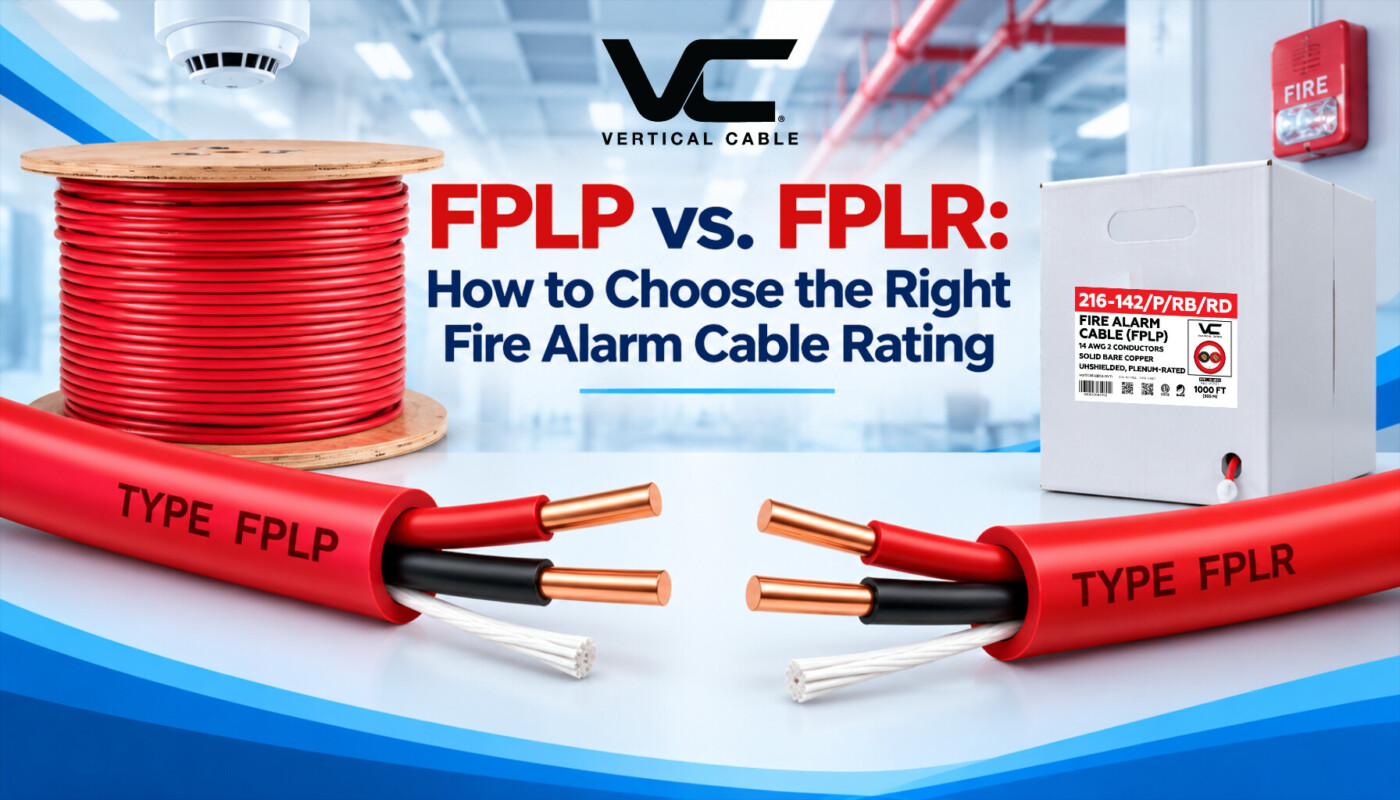
Pull the wrong fire alarm cable and the inspector won’t care how clean your terminations look. FPLP vs. FPLR is one of the most common questions on a commercial fire alarm job, and it comes down to one question: what space is the cable passing through? Both are power-limited fire alarm (PLFA) cables recognized by the National Electrical Code (NFPA 70). The difference is the fire test each one passes, and that test decides where each one can legally run.
Below, we break down what each rating means, how the substitution rule works, how to choose between 18/2 and 14/2, and why reel-in-box packaging saves time on the pull.
Question Decision Rule Passing through a plenum? Use FPLP. That means an air-handling space above a drop ceiling or below a raised floor. Running vertically through a shaft or between floors, and never touching a plenum? FPLR is enough. Not sure? FPLP covers both. |
|---|
What FPLP Cable Is Rated For
FPLP stands for Fire Power-Limited Plenum. To earn the rating, a cable must pass the NFPA 262 flame test, which measures both flame spread and smoke generation. It’s the most demanding test in the PLFA family, and it’s why FPLP is the only PLFA cable type you can run exposed through a plenum.
The reasoning is straightforward. A plenum is part of the building’s air distribution system. If a cable jacket burns there, the HVAC system can carry smoke to every space it serves. FPLP jackets are formulated to limit both the flame and the smoke.
Where you’ll use FPLP cable: above drop ceilings used as return-air plenums, under raised floors used for air handling, and anywhere the mechanical drawings show the cavity is part of the air path. If you’re not sure whether a ceiling is a plenum, check the HVAC drawings. If air moves through it, treat it as one.
What FPLR Cable Is Rated For
FPLR stands for Fire Power-Limited Riser. It’s tested to UL 1666, a vertical-shaft test that uses a substantial fire source to see whether a cable will carry flame to the floor above. Riser cable is built to keep fire from climbing the building along the cable itself.
Where you’ll use FPLR cable: vertical runs in shafts, floor-to-floor penetrations, and the backbone runs that carry circuits from the fire alarm control panel up to each floor in a multi-story building. On multi-dwelling unit projects, that same riser shaft may also carry the building’s fiber backbone. The Fiber Broadband Association’s white paper on making a building fiber-ready lays out how that backbone is typically structured, which helps when you’re coordinating space in a shared shaft.
What FPLR can’t do: it can’t run exposed through a plenum. Some installations allow lower-rated cable inside certain metal raceways, but that’s a conversation with your authority having jurisdiction (AHJ), not a default.
FPLP vs. FPLR Side-by-Side
FPLP | FPLR | |
|---|---|---|
Full Name | Fire Power-Limited Plenum | Fire Power-Limited Riser |
Fire Test | NFPA 262 (Flame Spread and Smoke) | UL 1666 (Vertical Flame Propagation) |
Plenum Spaces | Permitted | Not Permitted (Exposed) |
Riser Shafts / Floor-to-Floor | Permitted | Permitted |
General-Purpose Runs | Permitted | Permitted |
Can Substitute For | FPLR and FPL | FPL |
Typical Cost | Higher | Lower |
Here’s a detail that simplifies planning. On our unshielded 18/2 and 14/2 lines, the plenum and riser versions share the same solid bare copper conductors, PVC insulation, 300 V RMS rating, -20°C to +75°C operating range, and nominal outside diameter: 0.15 in. for 18/2 and 0.20 in. for 14/2. The jacket compound and listing are what change. Your conduit fill and support planning stay the same when you switch ratings. Only the pathway decides.
FPLP vs. FPLR and the Substitution Rule
The NEC lets a higher-rated cable substitute for a lower-rated one, never the reverse. For power-limited fire alarm cable, the hierarchy runs FPLP → FPLR → FPL. FPLP can go anywhere. FPLR can replace FPL in general-purpose runs. FPL stays on a single floor, outside plenums and risers.
Code Location Note In the 2023 NEC, the listing and installation requirements for PLFA cables moved into a new Article 722, which consolidates rules for power-limited cables. Article 760 still governs the fire alarm system itself. In jurisdictions still on the 2020 NEC, the substitution table is at 760.154. Confirm which edition your AHJ enforces before citing section numbers on a submittal. |
|---|
Read the jacket print, not the color. The rating is printed along the cable. On our fire alarm cable, you’ll find the TYPE FPLP or TYPE FPLR designation, the ETL mark, and sequential footage markers every few feet.
Many contractors standardize on FPLP for an entire building. One cable covers every pathway, a riser reel never ends up in a plenum by mistake, and the truck stock is simpler. The tradeoff is cost, so on riser-heavy jobs with limited plenum runs, splitting the order still makes sense. If you’re involved on the design side, ANSI/BICSI 007 is the BICSI standard that now covers electronic safety and security systems within a building’s broader ICT infrastructure. It’s a good reference for planning life-safety pathways alongside everything else in the ceiling.
18/2 or 14/2? Matching Gauge to the Circuit
The rating tells you where the cable can go. The gauge tells you how far the circuit can reach. Both lines come in 18 AWG and 14 AWG 2-conductor versions, and the resistance difference is significant:
Spec (Per Spec Sheet) | 18 AWG 2-Conductor (216-182) | 14 AWG 2-Conductor (216-142) |
|---|---|---|
Max DC Resistance per Conductor @ 20°C | ≤21.4 Ω/km (about 6.5 Ω per 1,000 ft.) | ≤8.45 Ω/km (about 2.6 Ω per 1,000 ft.) |
Conductor | Solid Bare Copper | Solid Bare Copper |
Nominal Outside Diameter | 0.15 in. (3.81 mm) | 0.20 in. (5.08 mm) |
18 AWG is the usual choice for lower-current circuits such as initiating device circuits and addressable signaling line circuits. 14 AWG is more common on notification appliance circuits, where horns and strobes draw more current and voltage drop over long runs becomes the limiting factor. Either way, size the circuit to the panel manufacturer’s wiring guidelines and a voltage drop calculation, and follow NFPA 72 for system requirements.
Why Reel-in-Box Packaging Matters on the Jobsite
All four SKUs below ship as 1,000 ft. of red cable in a reel-in-box. The reel sits inside the carton and pays out through the box, so you don’t need to haul a spool or set up a ladder, and the cable feeds without backlashing or kinking. The carton also protects the cable in the truck and on the floor, and the sequential footage print shows how much you have left before you start a long run.
FPLP (PLENUM) | FPLR (RISER) | |||
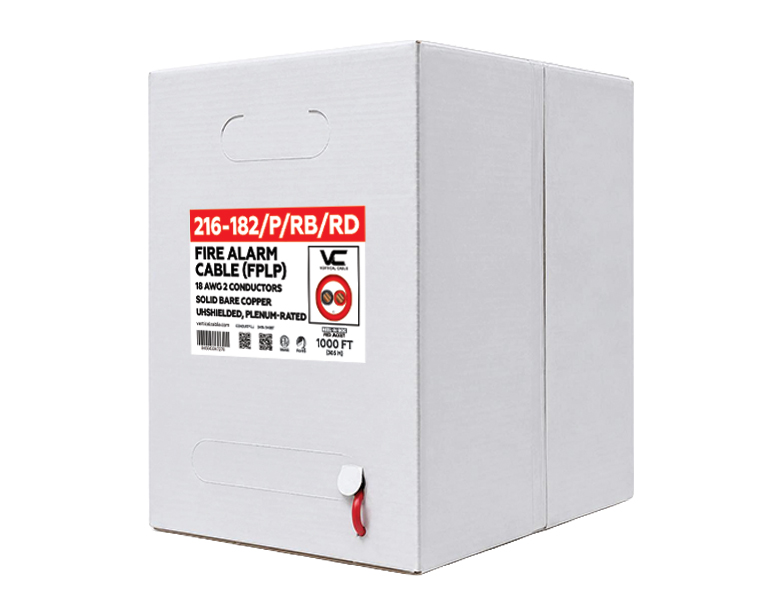 | 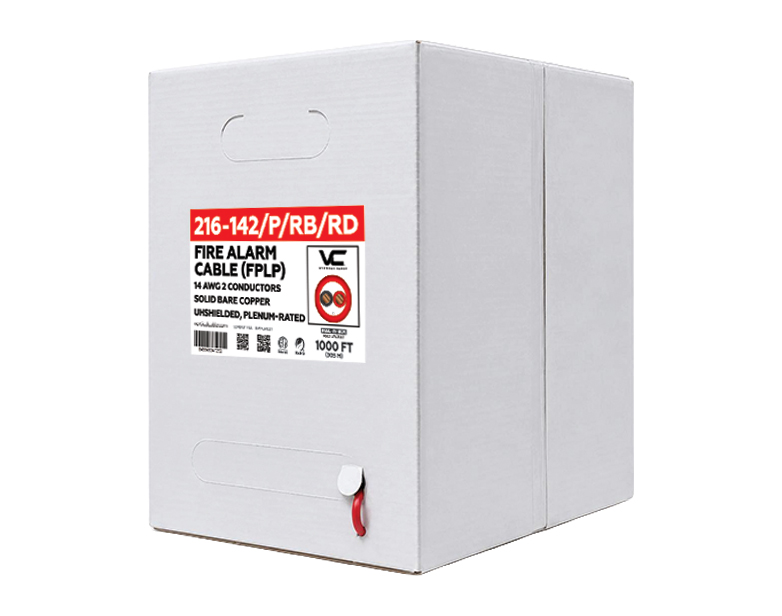 | 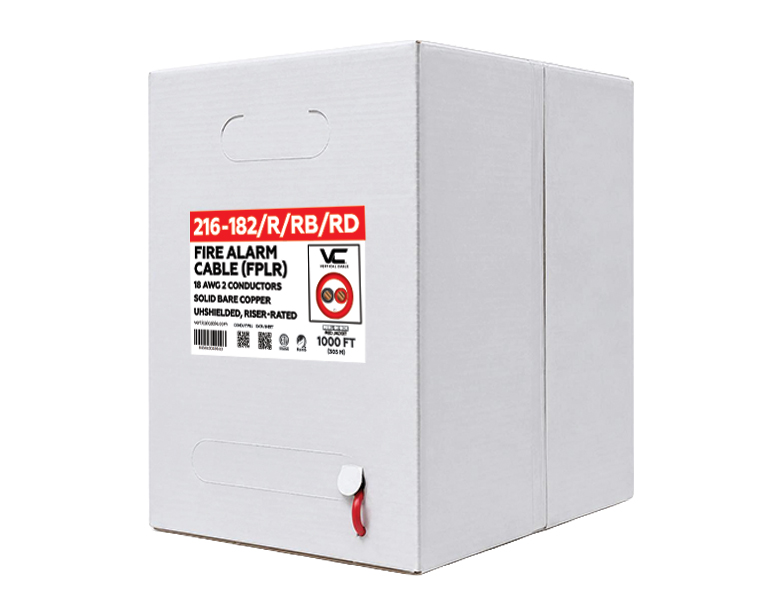 | 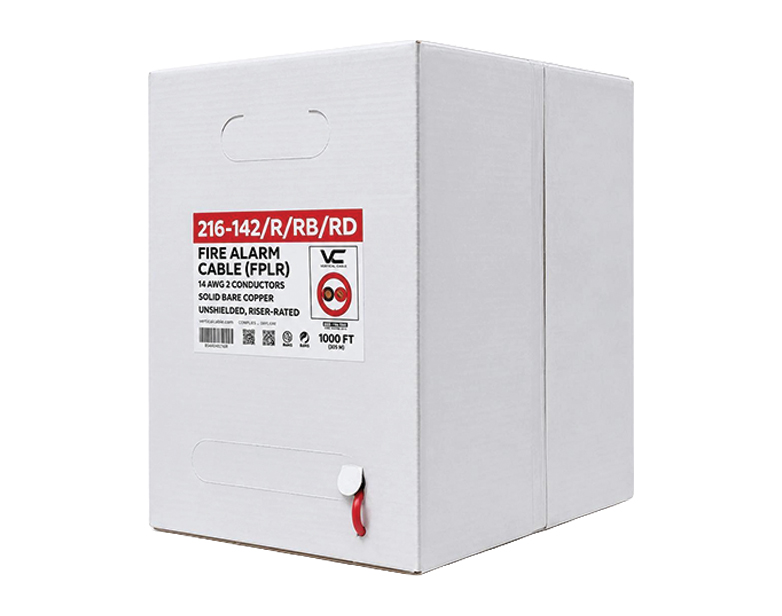 | |
SIZE: 18/2 | SIZE: 14/2 | SIZE: 18/2 | SIZE: 14/2 | |
– – – – – – – – – – – – – – – – – – – – – – – – – – – – – – | PACKAGE: 1,000 ft. Reel-in-Box | – – – – – – – – – – – – – – – – – – – – – – – – – – – – – – | ||||
WEIGHT: 20 lb. (9.07 kg) | WEIGHT: 38 lb. (17.24 kg) | WEIGHT: 20 lb. (9.07 kg) | WEIGHT: 38 lb. (17.24 kg) | |
Each of these is ETL listed, RoHS compliant, and built with a low-smoke PVC jacket and a polyester rip cord for fast stripping. They suit smoke detectors, pull stations, addressable fire alarm systems, and burglar alarm circuits. If you need other colors, the same cables are available on 1,000 ft. wooden spools. Reel-in-box packaging is red only.
Frequently Asked Questions
What does FPLP cable stand for?
FPLP stands for Fire Power-Limited Plenum. It’s a power-limited fire alarm cable that has passed the NFPA 262 flame and smoke test, making it the only PLFA cable type permitted in plenum spaces. It can also substitute for FPLR and FPL cable anywhere those are allowed.
What is the difference between FPLR and FPLP?
The difference is the fire test and where the cable may be installed. FPLR passes the UL 1666 vertical riser test and is rated for shafts and floor-to-floor runs. FPLP passes the stricter NFPA 262 plenum test and is rated for plenums, risers, and general-purpose runs. FPLP can replace FPLR, but FPLR can’t replace FPLP.
Can FPLR cable be used in a plenum?
Not exposed. Riser cable hasn’t passed the plenum smoke and flame test, so the NEC doesn’t allow it loose in an air-handling space. Some jurisdictions accept lower-rated cable inside certain metal raceways, so confirm with your AHJ before planning a run that way.
Does fire alarm cable need to be in conduit?
Not necessarily. The NEC permits listed power-limited fire alarm cable (FPL, FPLR, or FPLP) to be installed without raceway, as long as it’s properly supported and protected from physical damage. Local codes, project specs, or exposed locations can still require conduit, so check the spec and your AHJ.
Can you run fire alarm cable with power wiring?
No. Power-limited fire alarm conductors must stay physically separated from electric light, power, Class 1, and non-power-limited fire alarm conductors. They can’t share a cable, raceway, or enclosure with those circuits except under specific exceptions, such as a listed barrier.
STOCK THE RIGHT RATING FOR EVERY PATHWAY All four reel-in-box SKUs are part of our full fire alarm cable lineup, which includes FPLP plenum-rated and FPLR riser-rated cable in shielded and unshielded constructions from 12 AWG to 22 AWG. Not a Vertical Cable distributor yet? Apply for an account and our team will get you set up. |
|---|