
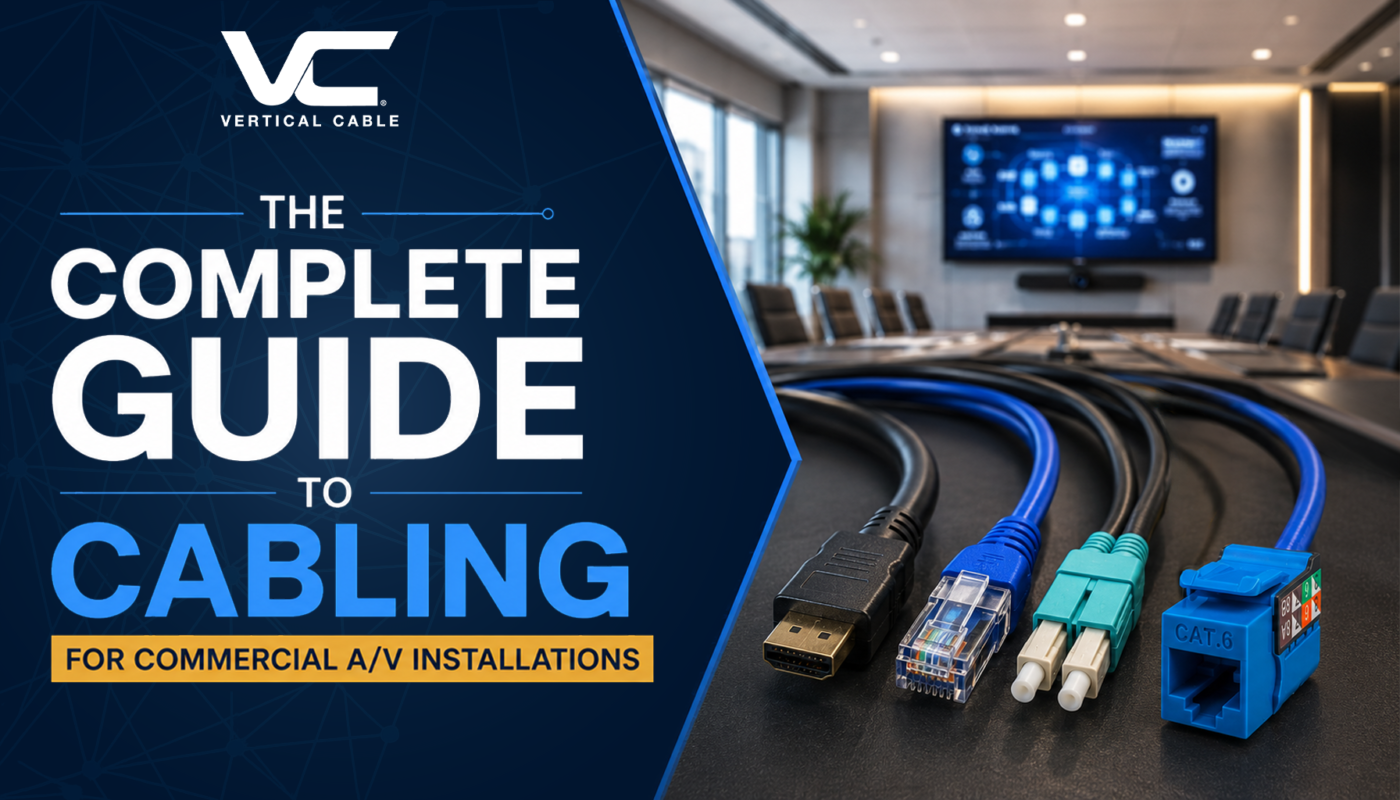
Modern commercial A/V work is about a lot more than the gear sitting in a rack. You’re dealing with converged IP networks, 4K video running over structured cabling, PoE-powered endpoints, and 70V audio, all sharing the same infrastructure. Get the cabling right, and everything works. Get it wrong, and you’re back on the job pulling wire six months after close-out.
In this guide, we’ll break down every cable type a low-voltage contractor needs to know for commercial A/V: category cable, fiber, audio cable, security cable, shielded cable, and plenum ratings. Whether you’re bidding on a new conference center or retrofitting a retail chain, the calls you make during rough-in set everything that comes after.
Why the Cabling Infrastructure Sets Your A/V System’s Performance Ceiling
Equipment gets upgraded. Cabling doesn’t, not without opening walls and ceilings.
That’s the practical argument for specifying correctly from day one. A/V over IP systems now push 4K uncompressed video across structured cabling. Wireless access points require Cat6A to deliver full bandwidth at the speeds Wi-Fi 6 and 6E are capable of. PoE+ and PoE++ devices draw 30–90 watts across the same pair count that used to carry 4 watts.
The governing standard for structured cabling in commercial environments is ANSI/TIA-568, maintained by the Telecommunications Industry Association. It covers performance specs for every category of copper and fiber cable used in horizontal and backbone runs, and it’s what your AHJ and commissioning engineers expect installations to reference.

Category Cable: The Foundation of Commercial A/V Infrastructure
Category cable is the workhorse of any commercial A/V installation. Choosing the right category isn’t about picking the newest, it’s about matching bandwidth and distance requirements to what the system actually needs now and what it will likely need over the installation’s useful life.
 CAT5E Image
Add src to <img>
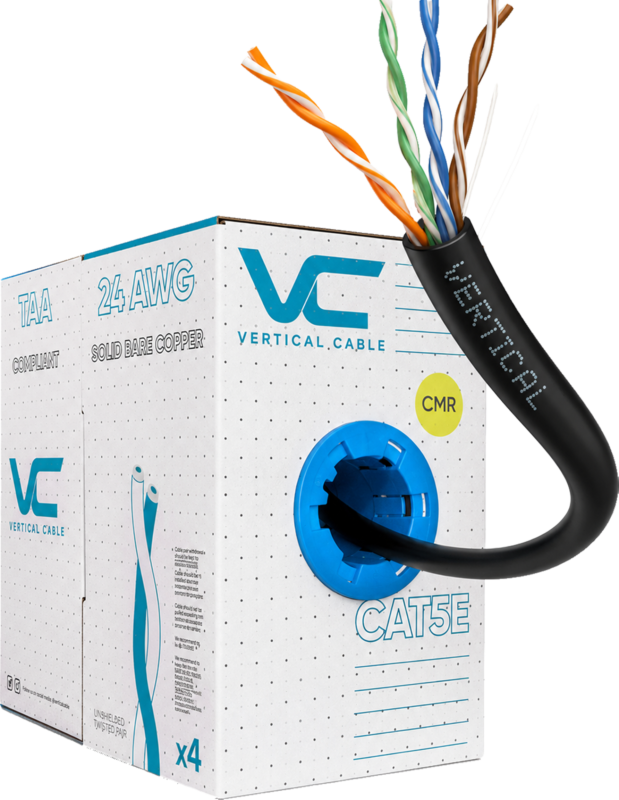
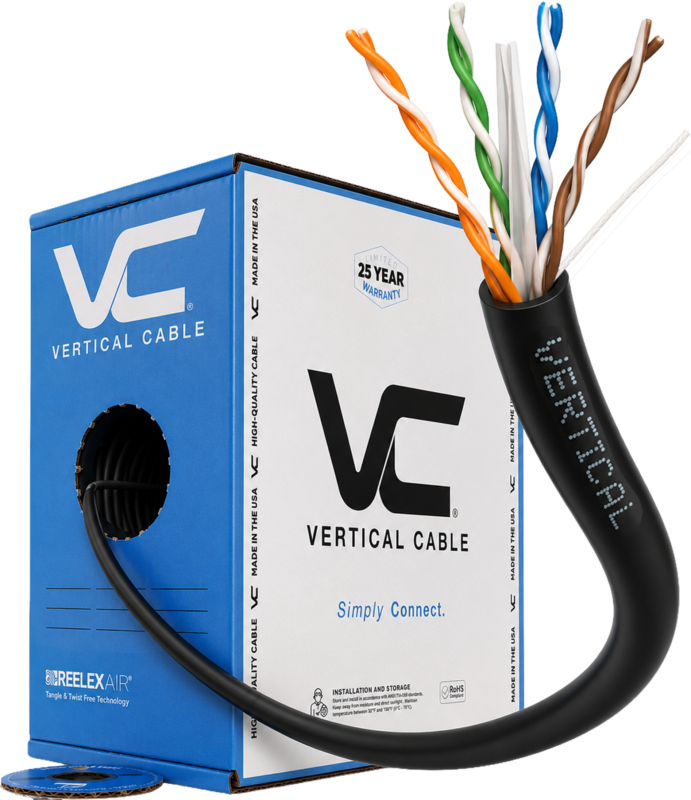
Rated to 100 MHz, supporting 1 Gbps (1000BASE-T) at the full 100-meter channel length per TIA-568. Adequate for standard IP endpoints, VoIP phones, and basic PoE devices — anywhere bandwidth demand is low and future upgrades aren’t on the table.
CAT5E has no defined pathway to 10 Gbps. For any new commercial A/V horizontal run, it’s a legacy choice — best suited for renovations and budget-driven builds where the end user has explicitly accepted the tradeoff.
Best for
- Standard IP endpoints
- VoIP phones
- Basic PoE devices
- Renovation & budget-driven builds
 CAT6 Image
Add src to <img>
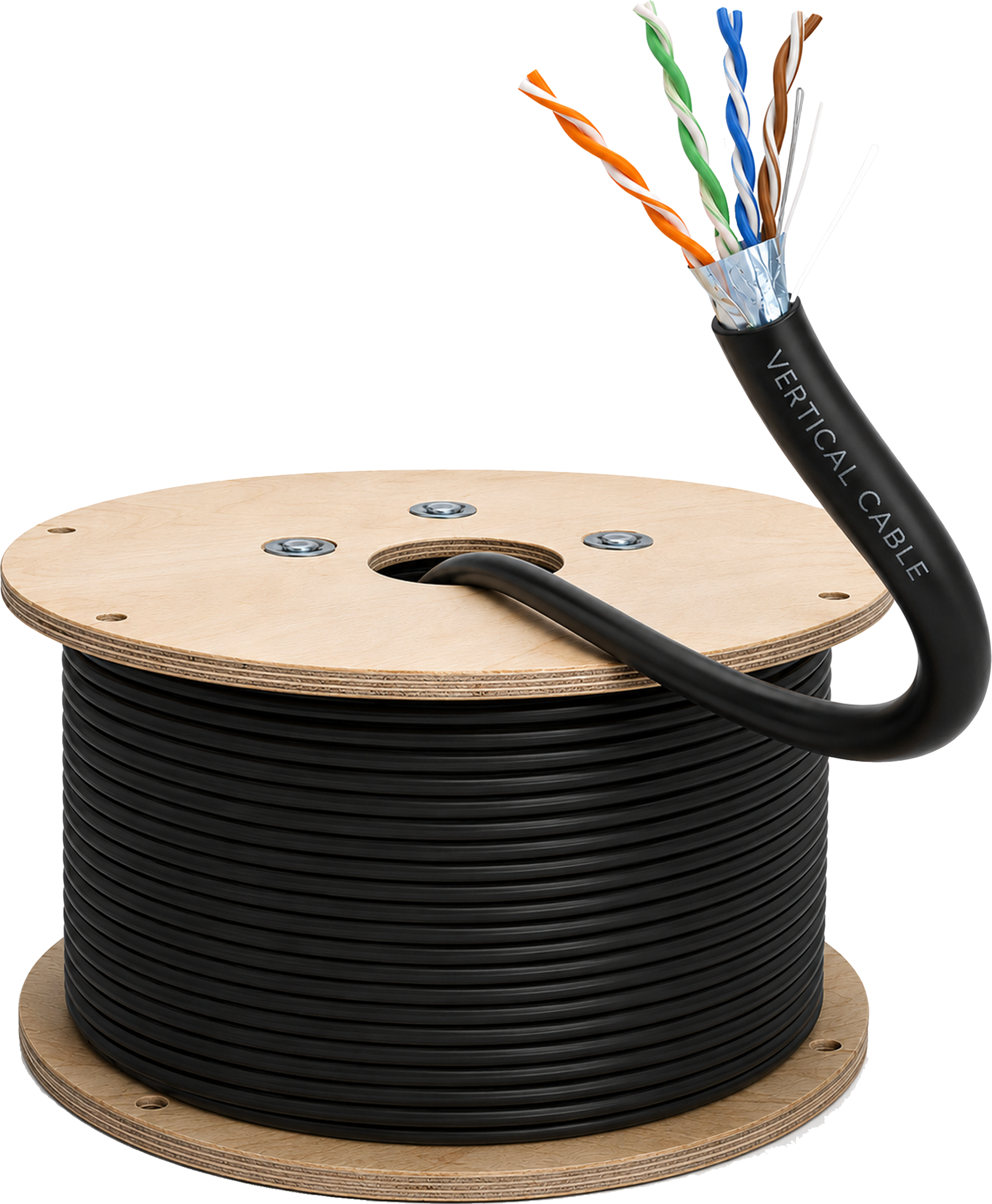
Rated to 250 MHz, supporting 1 Gbps at the full 100-meter channel. Also conditionally supports 10GBASE-T up to 55 meters, though TIA-568 requires alien crosstalk testing to confirm compliance at those distances.
Reduced crosstalk compared to CAT5E matters in bundled runs — the norm in commercial ceiling work. For most commercial A/V endpoints, CAT6 is the right call.
Best for
- IP cameras & AV-over-IP nodes
- PoE+ displays
- Wireless access points (standard)
- Bundled commercial ceiling runs
*10GBASE-T conditional at ≤55 m with alien crosstalk testing per TIA-568
 CAT6A Image
Add src to <img>
Specified under ANSI/TIA-568.2-D at 500 MHz — the only category cable rated for 10GBASE-T at the full 100-meter channel. A direct result of CAT6A’s significantly stricter alien crosstalk (AXT) specifications versus CAT6.
Warranted for
- 4K/8K AV-over-IP — SDVoE, NDI, high-channel Dante AES67
- Wi-Fi 6 & 6E access points (2.5G–10G uplink)
- Spine-leaf backbone in larger commercial installations
- PoE++ endpoints (90W) in bundled runs
Larger diameter than CAT6 — plan conduit fill and bend radius accordingly.
Fiber Optic Cable: When Copper Isn't the Right Tool
Copper category cable handles the vast majority of commercial A/V horizontal runs. But there are situations where fiber is the correct specification — and where running copper instead creates a problem you can't solve with a better switch.
Use fiber when:
- Backbone runs exceed 100 meters: copper hits a hard wall here; fiber extends to hundreds of meters, depending on type
- You're connecting separate buildings on a campus install: fiber solves both the distance and the ground loop/lightning exposure problems inherent in copper between buildings
- EMI immunity is required: fiber carries no electrical signal and is completely immune to interference from motors, generators, or adjacent power runs
- The backbone needs to scale beyond 10 Gbps: 40G and 100G are practical over fiber; they're not realistic options over copper category cable
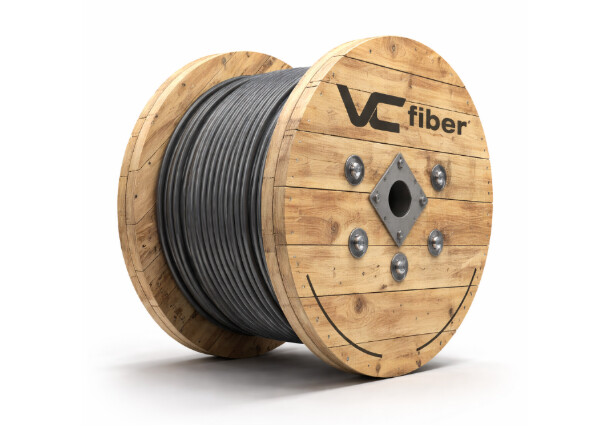
OS2 for Campus and Long-Haul Runs For building-to-building runs or any backbone exceeding 400 meters, OS2 singlemode fiber is the right specification. OS2 supports distances measured in kilometers rather than meters and is the correct choice for campus-wide A/V infrastructure. |
OM3 and OM4 for Commercial A/V Backbone Runs For intra-building backbone runs in commercial A/V, OM3 and OM4 multimode fiber are the standard choices.
Both use an aqua jacket and 50/125µm core, standard LC connectors, which are the norm in A/V and data environments. |
Audio Cable for Commercial A/V Systems
Commercial audio installations use several distinct cable types, and confusing them is a common source of performance problems.
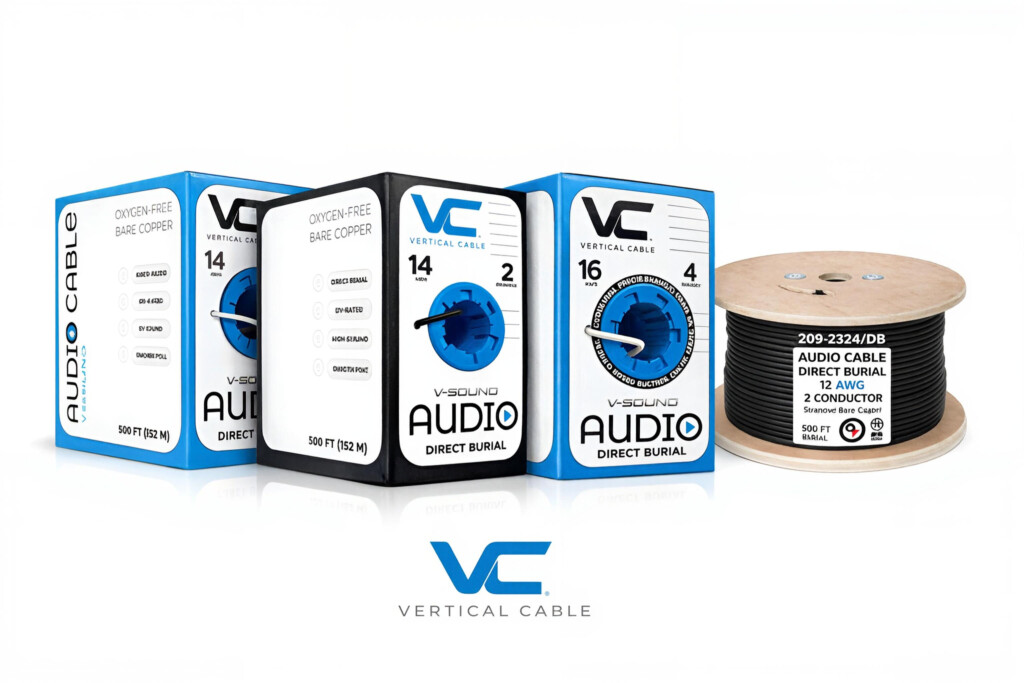
Speaker CableSpeaker cable handles the amplified signal between an amplifier or DSP and passive loudspeakers. Gauge selection is determined by run length and speaker impedance — in commercial installs, 12 AWG or 14 AWG is standard for most runs, with 70V/100V distributed audio systems allowing longer runs at smaller gauge because the transformer-based distribution significantly reduces current demand. Speaker cable is available in 2-conductor and 4-conductor configurations; 4-conductor is used for bi-amp wiring and some volume control applications. |
Audio CableShielded audio cable is the right spec for boardrooms, performance venues, and any run near dimmers, power conduit, or HVAC equipment. The shield rejects EMI and hum that would be audible in a critical listening environment. |
Jacket ratings matter here too: speaker cable running in-wall requires a CL2- or CL3-rated jacket; cable in plenum spaces requires a CL2P- or CL3P-rated jacket. This is an NEC requirement (NFPA 70), not optional.
Security Cable in Commercial A/V Environments
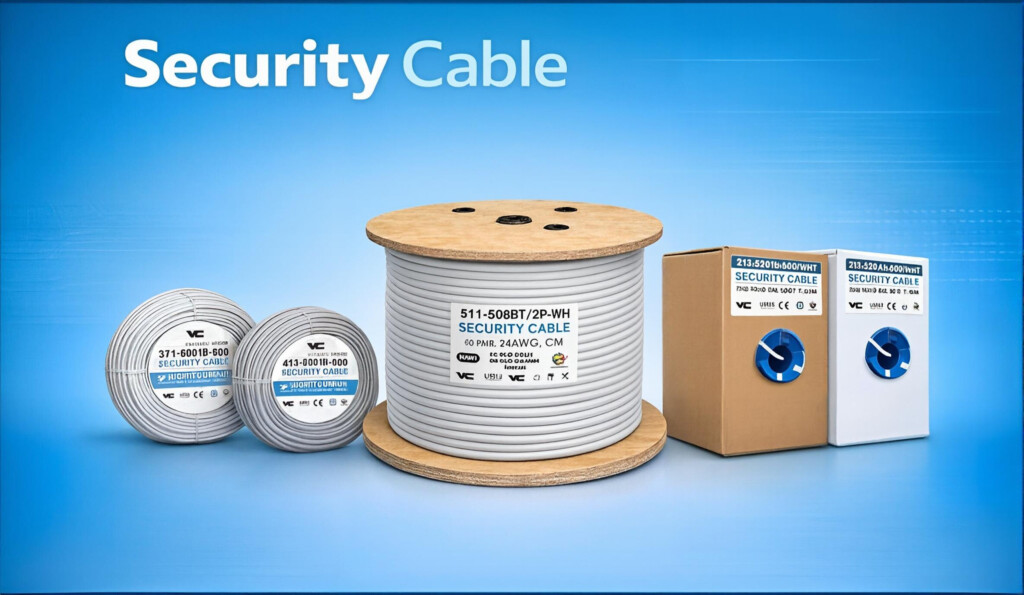
Security systems: IP cameras, access control readers, and intrusion detection are routinely integrated into A/V infrastructure, and the cable spec varies by device and distance.
IP cameras typically run on Cat6 for standard installs. For runs where PoE++ (90W) is required, or where the camera run exceeds 70 meters, Cat6A is the safer specification. For legacy analog cameras, RG59 or RG6 coaxial cable is the standard.
Access control and alarm runs typically use shielded or unshielded security cable in 18 AWG or 22 AWG configurations, depending on the device specifications. Shielded security cable is worth specifying in environments with significant electrical noise.
A note worth flagging for estimating: if a contractor isn't careful about which cable spec feeds which security device, PoE budget shortfalls show up after commissioning, not during rough-in.
Shielded Cable: When Commercial A/V Environments Demand It
Most commercial A/V installations don't require shielded copper category cable, standard UTP performs fine in clean environments. But there are specific scenarios where specifying unshielded cable creates a problem you can't fix at the rack.
Specify shielded cable (F/UTP or S/FTP) when:
- Runs pass near or parallel to the power conduit for more than a few feet
- The installation environment includes motors, HVAC equipment, variable-frequency drives, or fluorescent/dimmer-controlled lighting
- The application is a performance venue or boardroom where signal integrity is a hard requirement
- You're running shielded Cat6A in a dense 10GbE deployment where alien crosstalk mitigation is part of the design
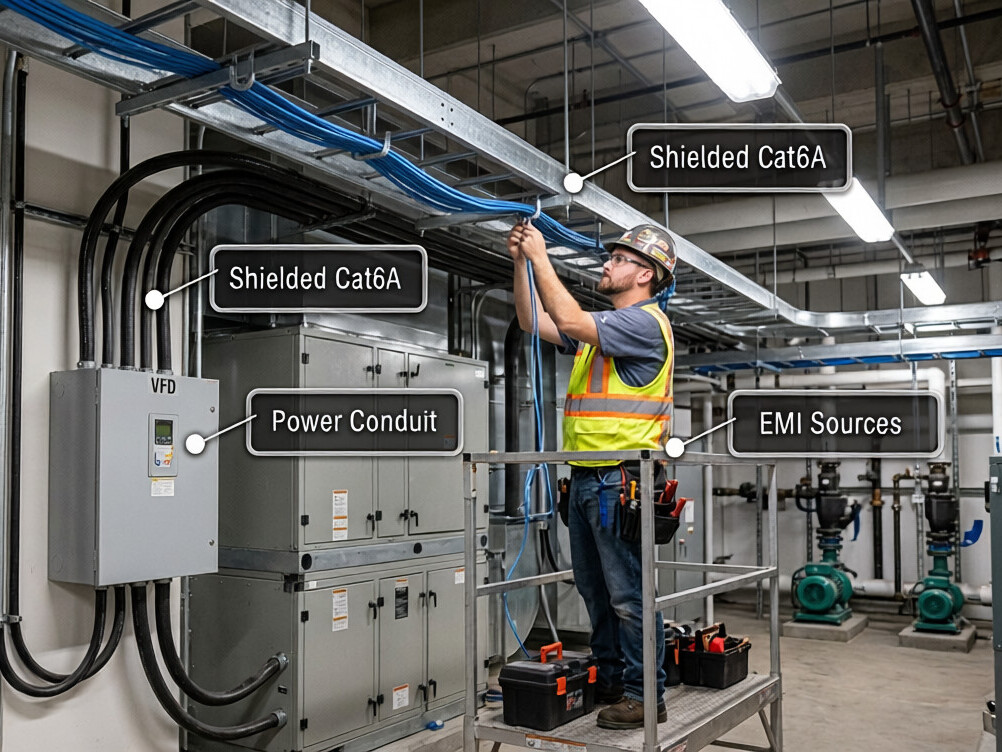
One critical note: shielded cable only performs as intended when properly grounded. A shield that's floating or improperly grounded can act as an antenna, worsening interference. Grounding and bonding for shielded cabling installations follow improperly grounded can act as an antenna, worsening interference ANSI/TIA-607.
Plenum Cable: Code Compliance Is Non-Negotiable
In commercial construction, cable frequently runs through air-handling plenums, the spaces above suspended ceilings or below raised floors used as return air pathways. Any cable running through these spaces must carry a plenum-rated jacket.
This applies to every cable type covered in this guide: Cat5e, Cat6, Cat6A, fiber, speaker cable, security cable, and shielded cable all have plenum-rated variants. A plenum jacket meets the NFPA 262 flame spread and smoke density requirements, standard riser or general-purpose jackets do not, and substituting them in a plenum space is a code violation under the NEC (NFPA 70).
The relevant NEC articles depend on cable type: Article 800 covers communications cable (category cable), Article 640 covers audio/video cable, Article 725 covers control cable, and Article 820 covers coaxial cable. Your AHJ may have additional requirements.
Order plenum cable for every ceiling run until you've confirmed the ceiling space is not used for return air.
Confirming afterward during commissioning is too late.
Structured Cable Best Practices for Commercial A/V
The spec on paper only translates to a performing system if the installation follows it. A few practices that separate a clean commercial A/V cabling job from a callback job:
Plan Pathways Before You Pull Conduit fill calculations and pathway separation from power runs (per NEC 300.3 and TIA-569 guidelines) are planning tasks, not field decisions. If you're sharing conduit or j-hooks with power, you've already created a problem for the A/V integrator. Label everything at rough-in — not at close-out. | Future-Proof Your Horizontal Runs The cost delta between CAT6 and CAT6A at rough-in is small. The cost of re-running cable because the system was upgraded to 10GbE AV-over-IP two years after installation is significant. When in doubt, run CAT6A. Install an empty conduit for future fiber backbone runs in new construction; it costs almost nothing at rough-in. | Termination Quality Matters As Much As Cable Quality A properly terminated CAT5E run will outperform a poorly terminated CAT6A run. Preserve the pair-twist integrity as close to the termination point as possible, seat the jacks fully, and use strain relief. This is where most installation failures originate — not in the cable itself. |
Frequently Asked Questions
What is structured cabling?
Structured cabling is a standardized cabling infrastructure, governed by ANSI/TIA-568, designed to support multiple hardware uses and provide a documented, consistent backbone for data, voice, and A/V systems. Rather than point-to-point wiring for individual devices, structured cabling centralizes runs to telecommunications rooms and patch panels, making moves, adds, and changes far easier to manage over the life of the building.
What is the difference between CAT6 and CAT6A for commercial A/V?
CAT6 supports 10 Gbps only up to 55 meters, and only conditionally, alien crosstalk testing is required to confirm compliance. CAT6A supports 10 Gbps over a full 100-meter channel length, as defined in TIA-568.2-D. For AV-over-IP systems running 4K video, high-channel-count Dante, or Wi-Fi 6/6E uplinks, CAT6A is the correct specification. For standard 1 Gbps endpoints, CAT6 is adequate.
Is CAT5E still worth using in a commercial A/V installation?
For new horizontal runs, CAT5E is difficult to justify unless the budget is severely constrained and future upgrades are explicitly off the table. It has no path to 10 Gbps, and the cost difference between CAT5E and CAT6 is marginal. CAT5E is a reasonable choice for legacy system renovations where you're extending an existing CAT5E infrastructure without a full replant.
When should I use fiber instead of copper in a commercial A/V install?
Fiber is the right call for backbone runs over 100 meters, any building-to-building connection, and environments where EMI immunity is required. For horizontal runs to individual endpoints, copper Cat6 or Cat6A remains standard. A common approach in commercial A/V is a fiber backbone between telecom rooms and copper horizontal runs to devices.
Can fiber optic cable be run alongside power cable?
Yes,for and this is one of fiber's practical advantages in commercial installations. Fiber carries light, not electricity, so it generates no electromagnetic field and is completely immune to EMI from adjacent power runs. Standard separation requirements that apply to copper data cable running near power (per TIA-569) do not apply to fiber. This makes fiber the obvious choice for backbone runs in electrically noisy environments like mechanical rooms or industrial facilities.
Specifying the right cable for a commercial A/V installation isn't complicated once you match the cable type to the environment and the application. The decisions that matter:
CAT6 vs. CAT6A | Fiber vs. Copper Backbone | Plenum vs. Riser | Shielded vs. UTP
All have clear answers when you know what the system demands.
Explore Vertical Cable Products Vertical Cable stocks the full range: CAT5E through CAT6A, OM3 and OM4 fiber, speaker cable, shielded and plenum options across every category. |
Planning A Commercial A/V Project And Want To Talk? We're at InfoComm, Booth #C5034 |