

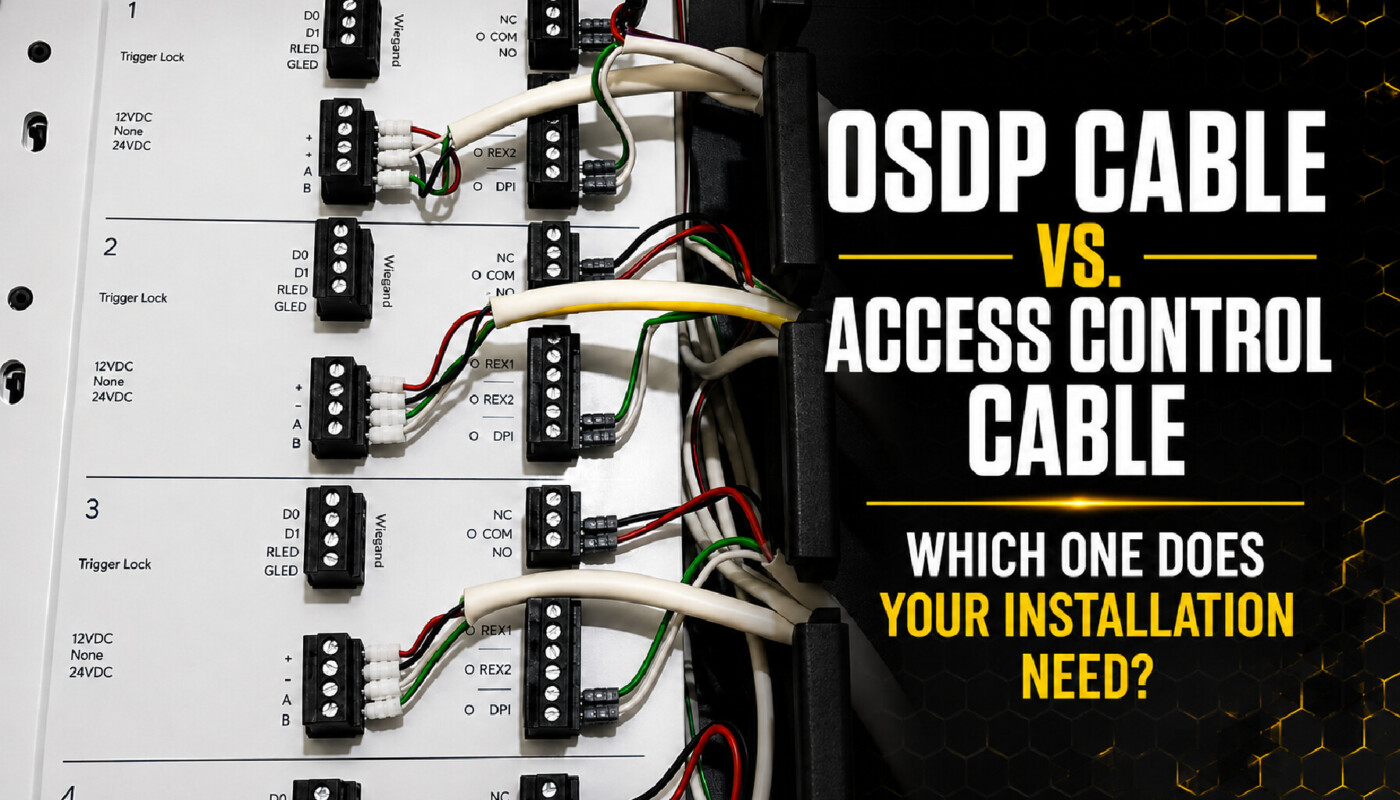
If you’ve spec’d access control jobs for a while, you’ve probably pulled the same multi-component cable for every reader, lock, and door contact on the project — and it worked fine, because the system was talking. Now more manufacturers are shipping panels and readers that default to OSDP, and the wiring question comes up on every bid: can you still run the same cable, or do you need something built for OSDP?
The short answer: it depends on what’s inside the jacket. Standard access control cable and OSDP cable look similar from the outside — both are multi-component, plenum-rated bundles, and both get called composite cable — or, on the job site, banana cable, for the way the bundled round components look stacked side by side — since they bundle several conductor groups into one jacket. But they’re built around two different communication protocols, and that changes what’s inside each component. Here’s the actual breakdown.
Quick Answer A standard access control cable (like Vertical Cable’s 214-2300s Series) is built around a 3-pair shielded component sized for Wiegand-style readers, which require multiple discrete conductors for data, LED, and tamper lines. OSDP cable (like the 214-2360s Series) replaces that 3-pair component with a single shielded pair engineered for RS-485 — OSDP’s actual transport layer — including a controlled-impedance, low-capacitance design that Wiegand wiring never needed. |
If your panel and readers are OSDP-only, run OSDP cable. If you’re not sure yet, or you’re supporting legacy Wiegand readers alongside newer OSDP-capable ones, standard access control cable is still the safer all-purpose pull.
What’s Inside Standard Access Control Cable
Vertical Cable’s 214-2300s Series is a 4-component, CMP/CL3P plenum-rated cable built specifically for Wiegand-era access control wiring. It’s designed so one pull feeds everything at the door:
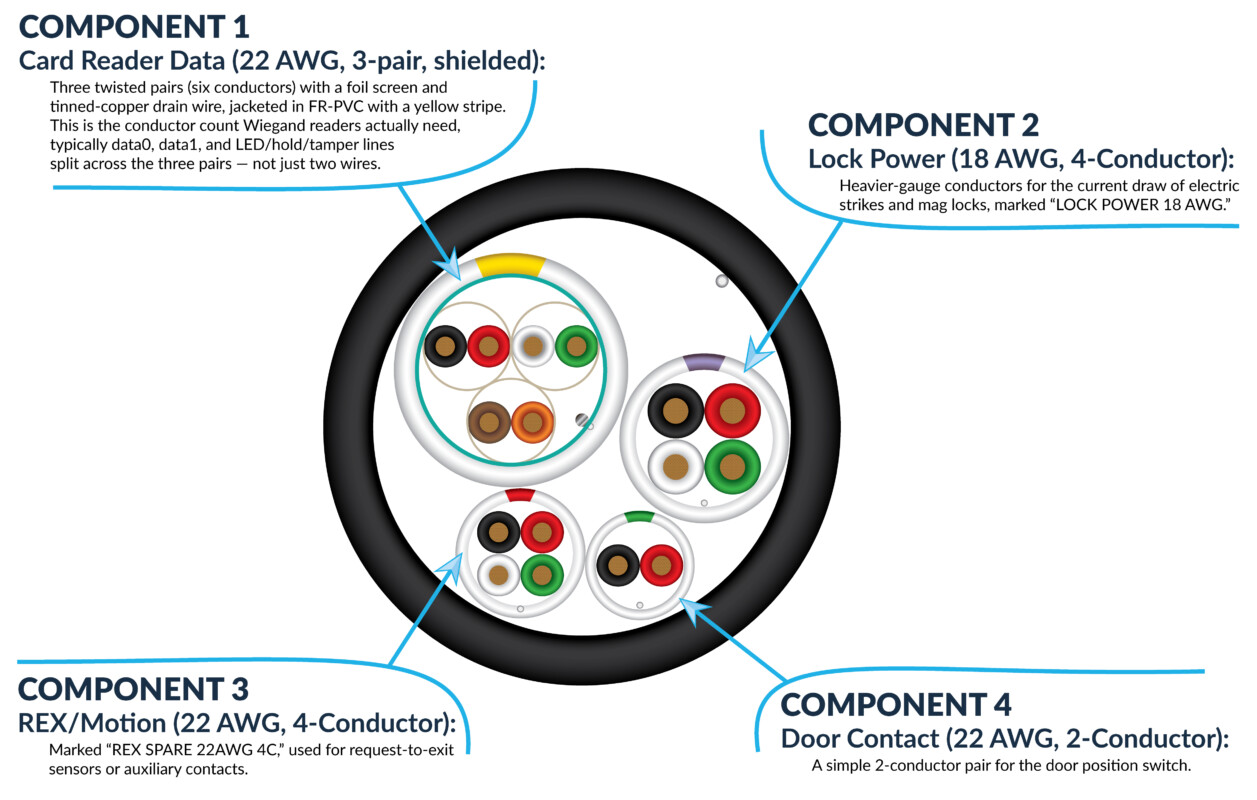
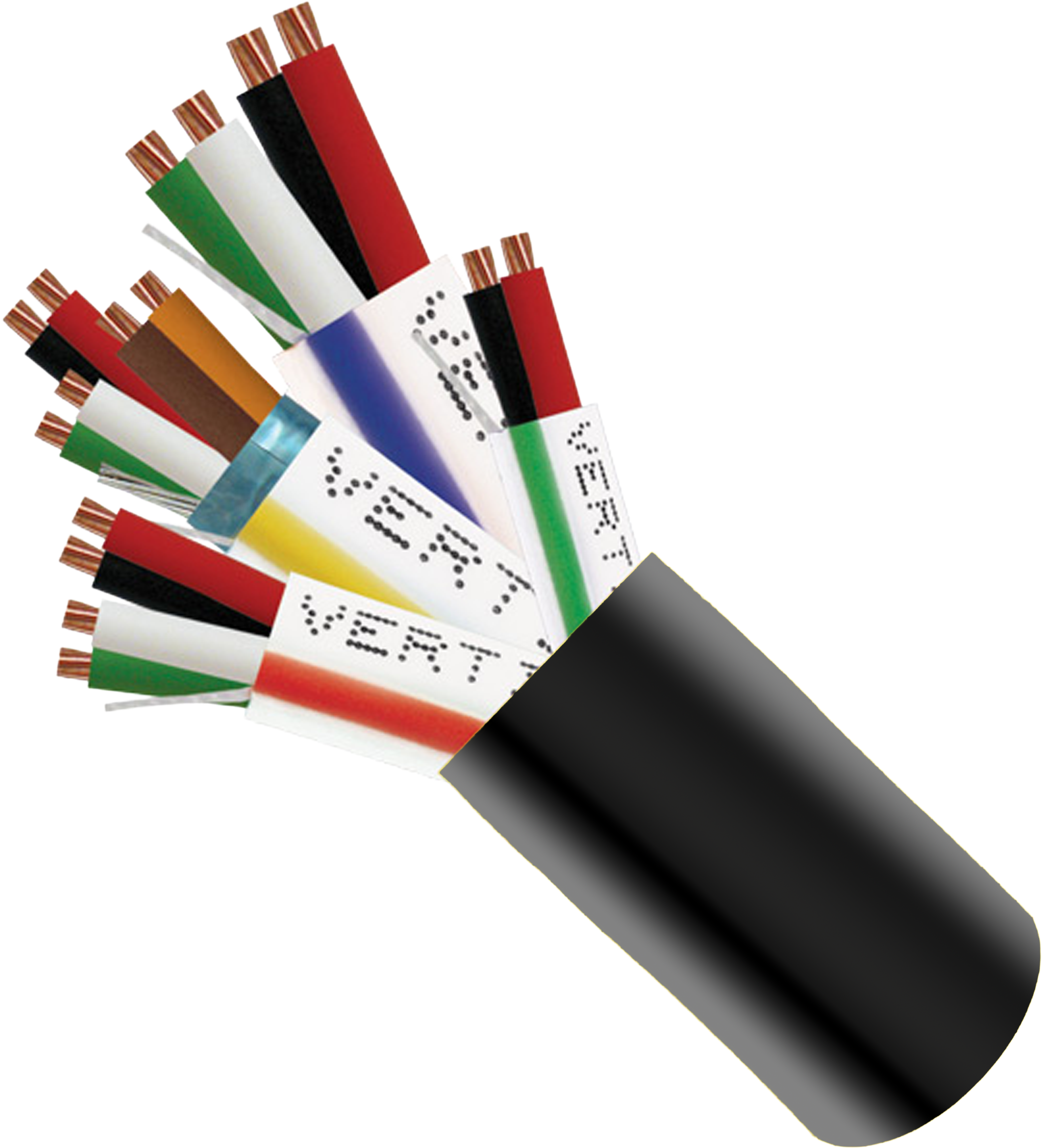
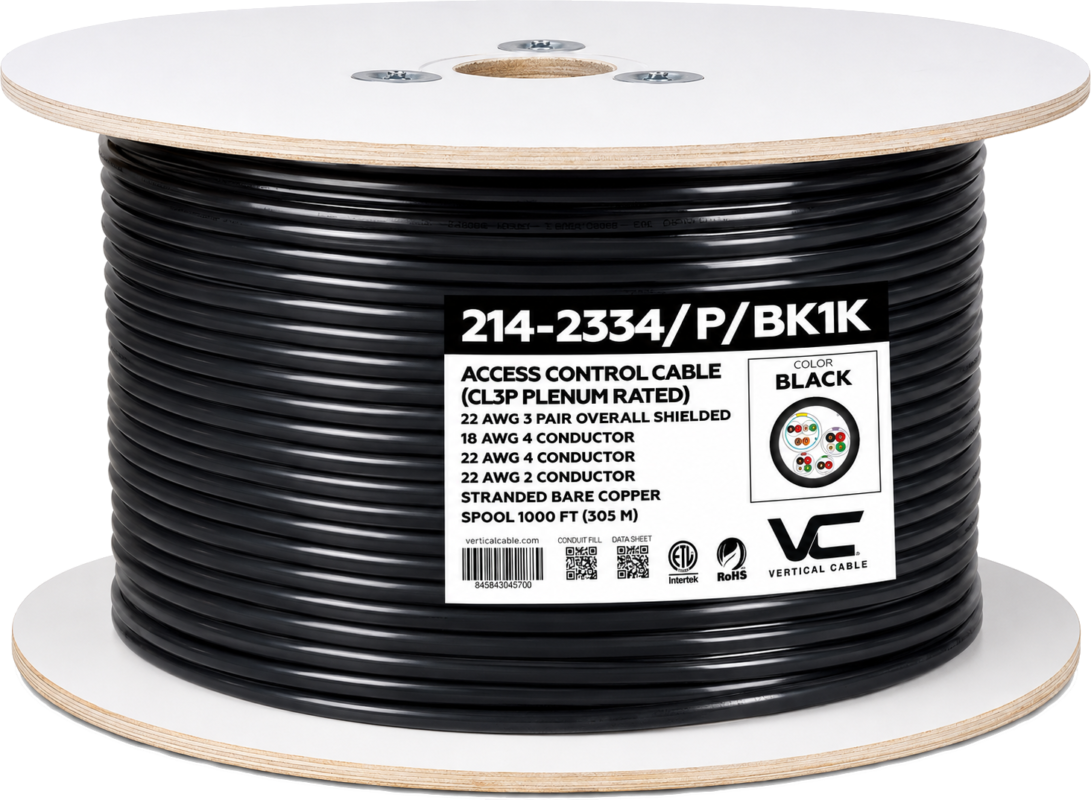
All four components ride under a single low-smoke FR-PVC overall jacket (0.41 in. OD), rated CMP/CL3P for plenum spaces and ETL listed. The cable exceeds ANSI/TIA-568.2-D and ISO/IEC 11801 performance requirements and carries a CAN/CSA-C22.2 No. 214 rating, with a 300 VRMS voltage rating and a -4°F to 167°F operating range.
What’s Inside OSDP Cable
The 214-2360s Series keeps the same four-job structure — reader, lock power, REX, door contact — but the reader component is rebuilt from the ground up for OSDP’s RS-485 transport instead of Wiegand’s parallel-wire approach:
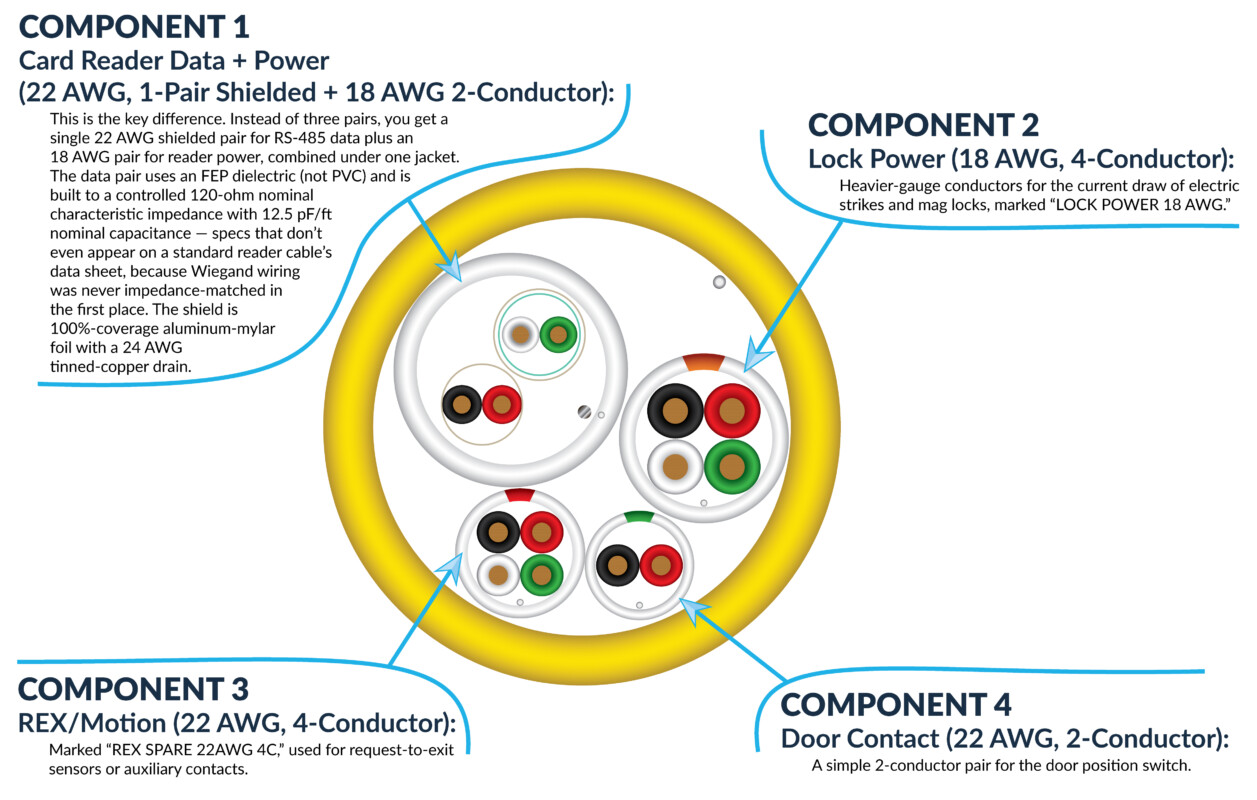
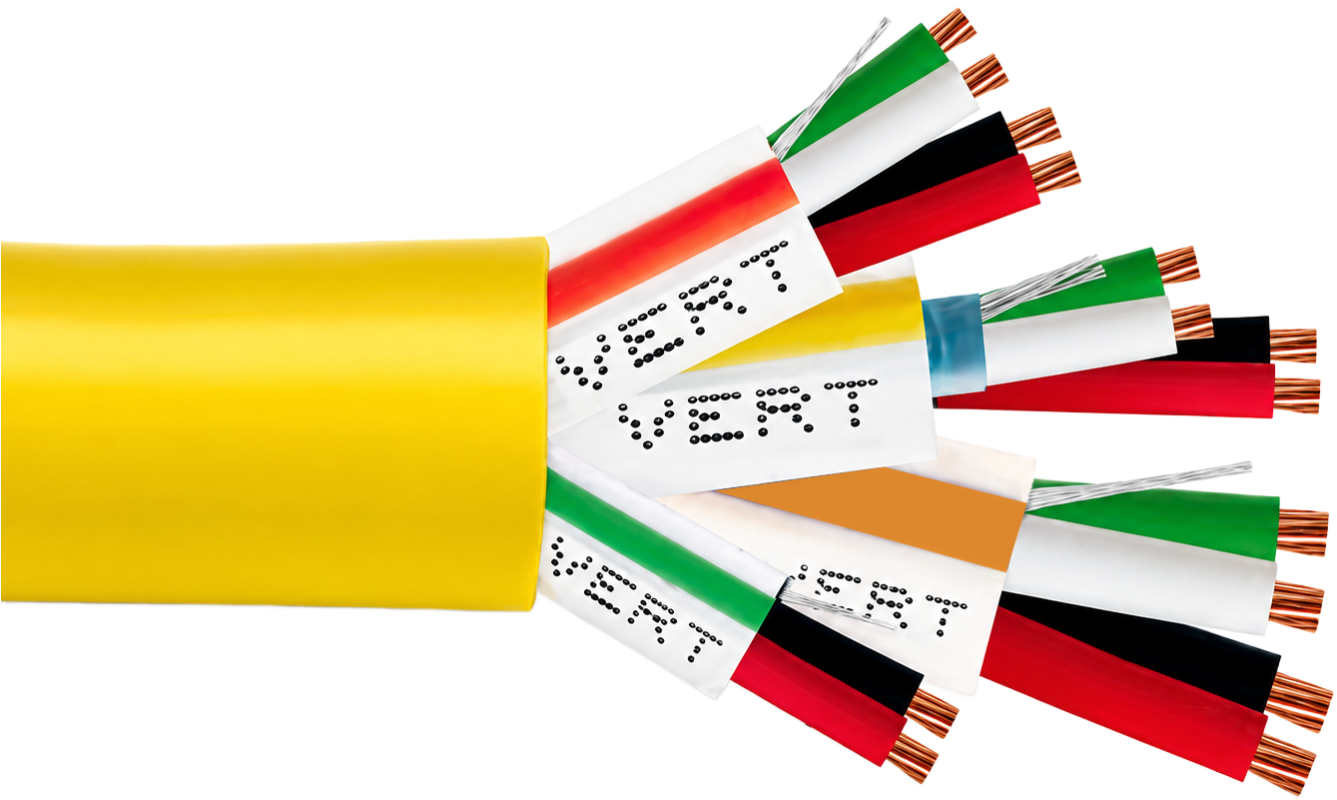
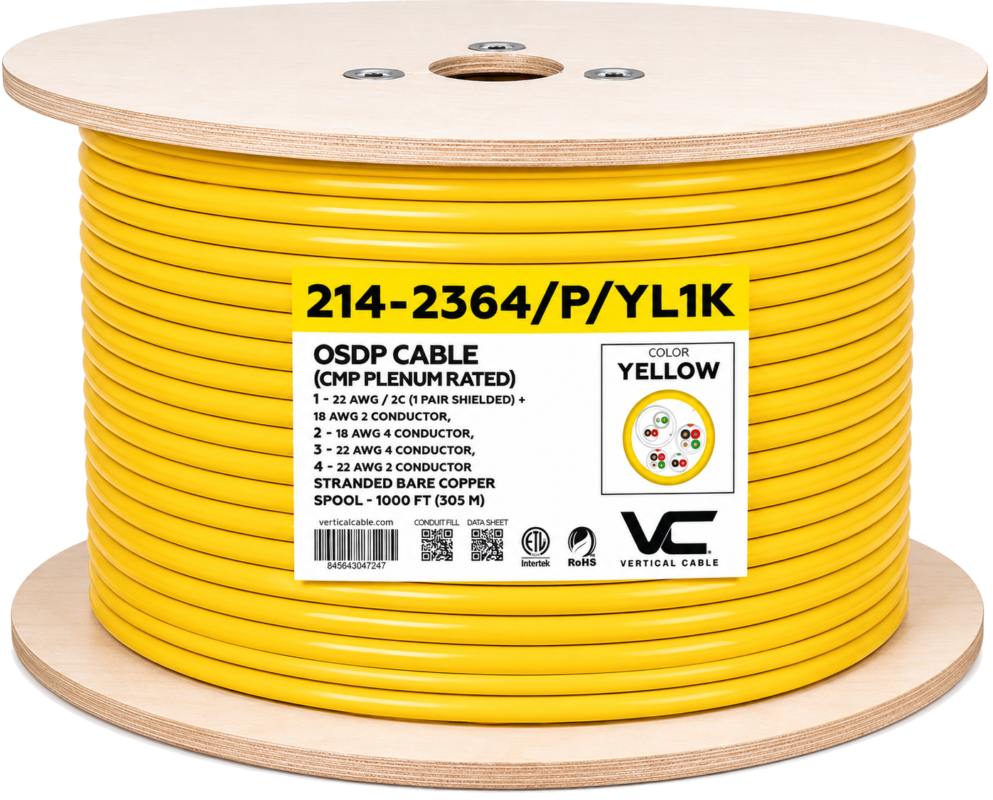
The overall jacket is low-smoke PVC, CMP plenum-rated, ETL listed, RoHS compliant, with the same 300 V RMS rating and an operating range of -20°C to 75°C (-4°F to 167°F) as the standard cable. It currently ships on 1,000 ft. spools in white or yellow—no reel-in-box or 500 ft. option yet, and no black jacket option — which matters if your color-coding runs by function on a larger job.
The Core Difference: Wiring for Wiegand vs. Wiring for RS-485
This is the part that actually matters when you’re choosing a cable, not just a spec sheet curiosity.
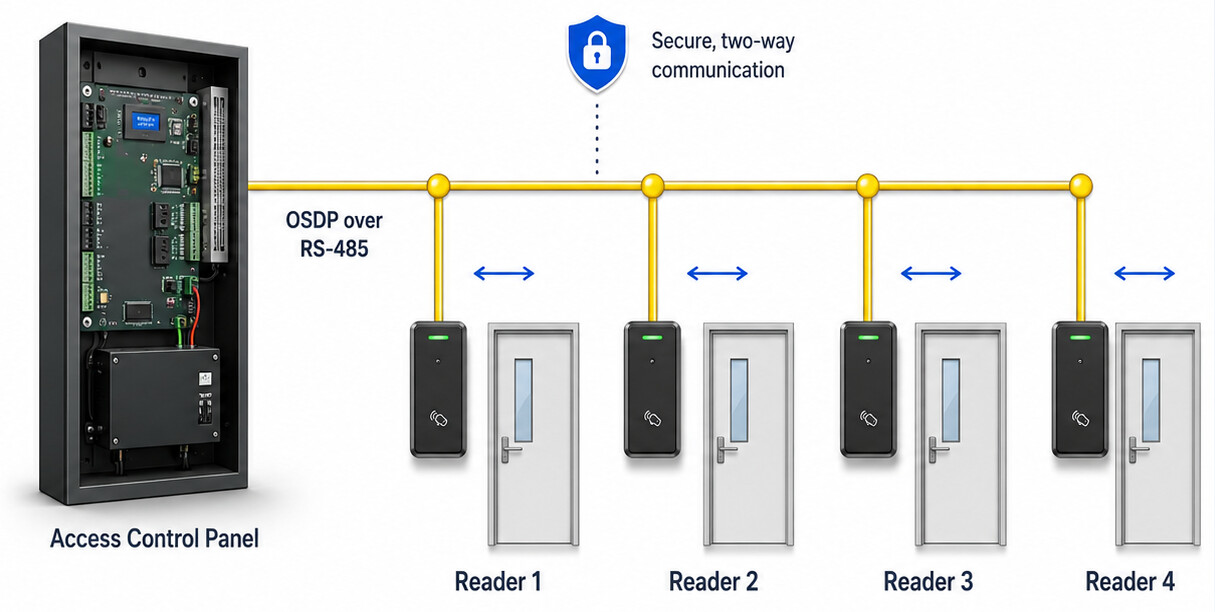
Wiegand is a one-way, unencrypted protocol that sends credential data over dedicated DATA0/DATA1 lines — which is why a legacy reader cable needs three full pairs at the reader end to cover data, status, and tamper conductors. OSDP, the Security Industry Association’s standard (published internationally as IEC 60839-11-5), is bidirectional and runs over RS-485 — a multi-drop serial bus that needs only one twisted pair for data, supports up to 32 devices on a single run, and adds AES-128 encryption plus reader supervision that Wiegand can’t do at all.
Because RS-485 is a differential signaling bus, the data pair’s electrical characteristics matter in a way Wiegand’s never did.
Key Spec RS-485 wiring is generally specified around a 120-ohm characteristic impedance to prevent signal reflections on longer or multi-drop runs — exactly the spec Vertical Cable builds into the 214-2360s Series’ data pair, and exactly what’s absent from a standard reader cable’s 3-pair component. |
You can sometimes get away with running shielded Cat5e or generic 22/6 shielded cable on a short, single-drop OSDP install, but on longer runs or multi-drop reader chains, an impedance-matched pair is what keeps the bus from throwing communication errors.
FEATURE | 214-2300s ACCESS CONTROL | 214-2360s OSDP |
|---|---|---|
Reader communication | Traditional Wiegand | OSDP (RS-485) |
Data Flow | One-way | Two-way |
Cybersecurity | No encryption | Supports AES-128 Secure Channel |
Reader Pair | 22 AWG/3P shielded (3 twisted pairs) | Dedicated 22 AWG/2 shielded OSDP pair |
Characteristic Impedance | Not specified | 120 Ω (RS-485 optimized) |
Capacitance | Standard access control | 12.5 pF/ft for OSDP pair |
Shielding | Shielded reader component | Dedicated shielded communication pair |
Future Readiness | Legacy systems | Modern access control systems |
Maximum Distance | ~500 ft. (Wiegand typical) | Up to 4,000 ft. (1,200 m) |
Full Spec Comparison: 214-2300s vs. 214-2360s
SPEC | Standard Access Control Cable (214-2300s) | OSDP Cable (214-2360s) |
|---|---|---|
Protocol Target | Wiegand-style readers | OSDP (RS-485) |
Reader/Data Component | 22 AWG, 3-pair, shielded (foil + drain wire) | 22 AWG, 1-pair shielded (FEP, 120 Ω nom.) + 18 AWG 2-conductor power, combined |
Lock Power | 18 AWG, 4-Conductor | |
REX/Motion | 22 AWG, 4-Conductor | |
Door Contact | 22 AWG, 2-Conductor | |
Overall Jacket OD | 0.41 in. (10.50 mm) | 0.433 in. (11 mm) |
Jacket Rating | CMP/CL3P, Plenum | CMP, Plenum |
Voltage Rating | 300 V RMS | |
Operating Temperature | -4°F to 167°F (-20°C to 75°C) | |
Colors | Black, White, Yellow | White, Yellow |
Packaging | 500/1,000 ft. Wooden Spool, 500 ft. Reel-in-Box | 1,000 ft. Wooden Spool |
Listings | ETL, RoHS, CAN/CSA-C22.2 No. 214 | ETL, RoHS |
When To Use Each
Use Standard Access Control Cable When
 | Use OSDP Cable When
 |
If you genuinely don’t know which protocol the final hardware will use — common on retrofit bids where the access control vendor hasn’t been finalized — standard access control cable is the more conservative pull, since most OSDP installs on short, single-drop runs will still function over a well-shielded 3-pair cable, even without the impedance-matched data pair.
Installation Notes
CODE COMPLIANCE Both series are CMP/CL3P or CMP plenum-rated, which matters anywhere the run passes through ductwork, drop ceilings, or other air-handling spaces under NFPA 70 (NEC) Article 800 — don’t substitute a non-plenum-rated cable in those spaces regardless of which protocol you’re wiring for. |
Both cables also ship with individual rip cords on every component, which is worth factoring into your termination time on multi-door jobs since you’re not slitting jacket by hand at every box.
Case Study: A Facility Upgrading from Wiegand to OSDP
A commercial facility is upgrading its access control system in phases. Some existing doors will continue using Wiegand readers, while new entrances and higher-security areas will use OSDP readers. | ||
Existing Wiegand Doors: The existing standard access control cable can remain in place while those readers continue operating on Wiegand. During an OSDP retrofit, existing cabling may also be reusable, but SIA recommends testing it first to confirm it can reliably support OSDP communication. | New OSDP Doors: For new OSDP installations, the installer specifies cable designed for 2-wire RS-485 communication, such as Vertical Cable’s 214-2360s Series OSDP Cable. SIA specifically recommends RS-485-rated cable for new OSDP installations. | Higher-Security Areas: A server room and other sensitive entrances are upgraded to OSDP to leverage bidirectional communication, device supervision, and OSDP Secure Channel encryption. SIA recommends Secure Channel for encrypted communication between readers and controllers. |
Frequently Asked Questions
What is an OSDP cable?
OSDP cable is wiring built for the Security Industry Association’s Open Supervised Device Protocol — typically a 4-component cable like the 214-2360s Series, where the reader-data component is a controlled-impedance, shielded pair sized for RS-485 instead of the multi-pair wiring Wiegand readers need. It still carries the same lock power, REX, and door-contact components as a standard access-control cable.
Is OSDP the same as RS-485?
No. OSDP is the communication protocol — the rules for how a panel and a reader exchange encrypted bidirectional data. RS-485 is the physical wiring standard that the protocol runs on. OSDP cable is wiring built to RS-485’s electrical specs (twisted, shielded, ideally 120-ohm impedance) specifically to carry an OSDP connection reliably.
What’s the difference between OSDP cable and Wiegand cable?
Wiegand cable needs three full pairs at the reader to carry separate, unencrypted data and status lines. OSDP cable replaces that with a single impedance-matched pair, because OSDP’s RS-485 bus only needs two wires for bidirectional, encrypted data — and can support multiple readers on that same pair, which Wiegand can’t do.
Can you use Cat6 for an access control cable?
Shielded Cat6 can carry a Wiegand or short-run OSDP signal, but it’s not built for the job—it won’t include the lock power, REX, and door contact components. A 4-component access control cable is bundled into a single jacket, so you’d still need separate runs for those functions. It’s a workaround, not a substitute for purpose-built access control or OSDP cable.
How far can access control cable run?
It depends on the protocol, not just the cable. Wiegand wiring is generally limited to around 500 ft. before data corruption becomes a risk. OSDP, running over RS-485, supports runs of up to roughly 4,000 ft. and can serve multiple readers on a single run — which is why longer or multi-door pulls are increasingly wired for OSDP.
Shop Access Control Cable and More Standard access control cable and OSDP cable solve the same door—reader, lock, REX, contact—but only one is built around the electrical realities of an RS-485 bus. If you’re still wiring Wiegand or mixed-protocol panels, the 214-2300s Series remains the safer, more flexible pull. Once a job is confirmed OSDP-only, the 214-2360s Series’ impedance-matched reader pair keeps a multi-drop run clean over distance—not a nice-to-have, but the actual spec the protocol calls for. Vertical Cable’s OSDP cable is releasing September 18th |