
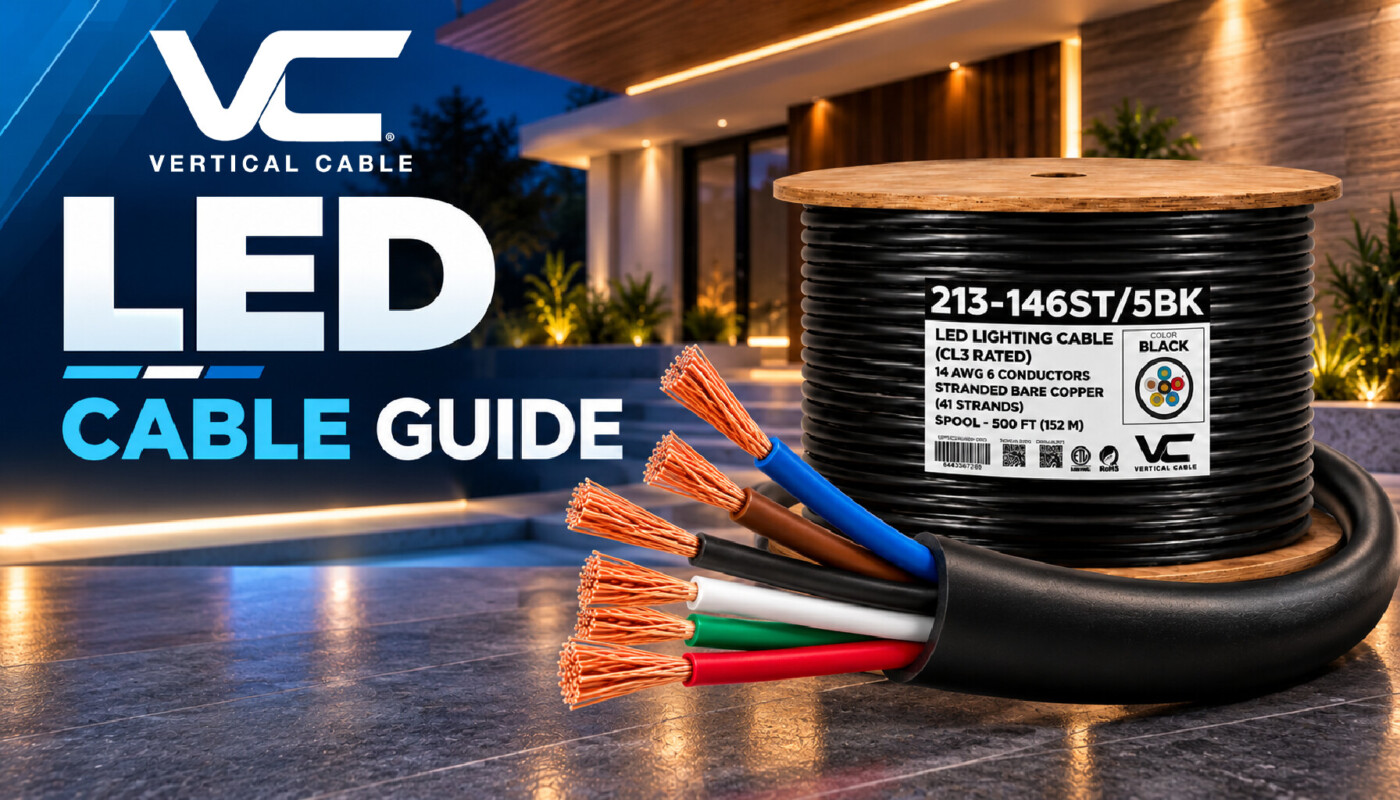
LED lighting projects live or die by the cable behind the wall—not the fixture. An LED cable that’s undersized for the run distorts color and dims output at the far end, and one with the wrong jacket rating can get you flagged at inspection or fail outright once it’s buried. Whether you’re wiring a single-color strip run or a full RGB+CCT architectural install, the right LED cable comes down to three decisions: conductor count, gauge, and jacket rating.
What is LED Cable, Technically Speaking?
LED cable isn’t a formal NEC category — it’s a market name for low-voltage, multi-conductor cable built for Class 2 and Class 3 power-limited circuits, the same circuit class that covers security, intercom, and control wiring. NEC (NFPA 70) Article 725, which historically set the voltage and current limits, listing requirements, and installation rules for Class 2 and Class 3 wiring. Installers working from the 2026 edition should note that a chapter-wide restructuring has begun redistributing limited-energy circuit requirements out of Article 725 into a new Article 722 — confirm which edition your local jurisdiction has adopted before citing article numbers on a job.
A CL3 rating means the cable is listed for a Class 3 circuit — up to 300 volts and a higher power ceiling than CL2 — and cleared for use inside walls and ceilings. That listing matters because ordinary lamp cord or unlisted “LED wire” sold for hobbyist use isn’t rated for in-wall installation, regardless of gauge.
Sizing the Conductor: 14 AWG vs. 16 AWG
For LED runs, gauge selection is driven almost entirely by voltage drop, not ampacity—a 12V or 24V system loses a much larger percentage of its supply voltage over distance than a 120V circuit does, and that percentage shows up as visible dimming or color shift before it becomes a safety issue. As a rule of thumb, keep voltage drop under 3% of the supply voltage, and always calculate for the round-trip distance (feed plus return), not just the one-way run.
GUAGE | BEST FOR | Typical 24V run before injection needed* |
|---|---|---|
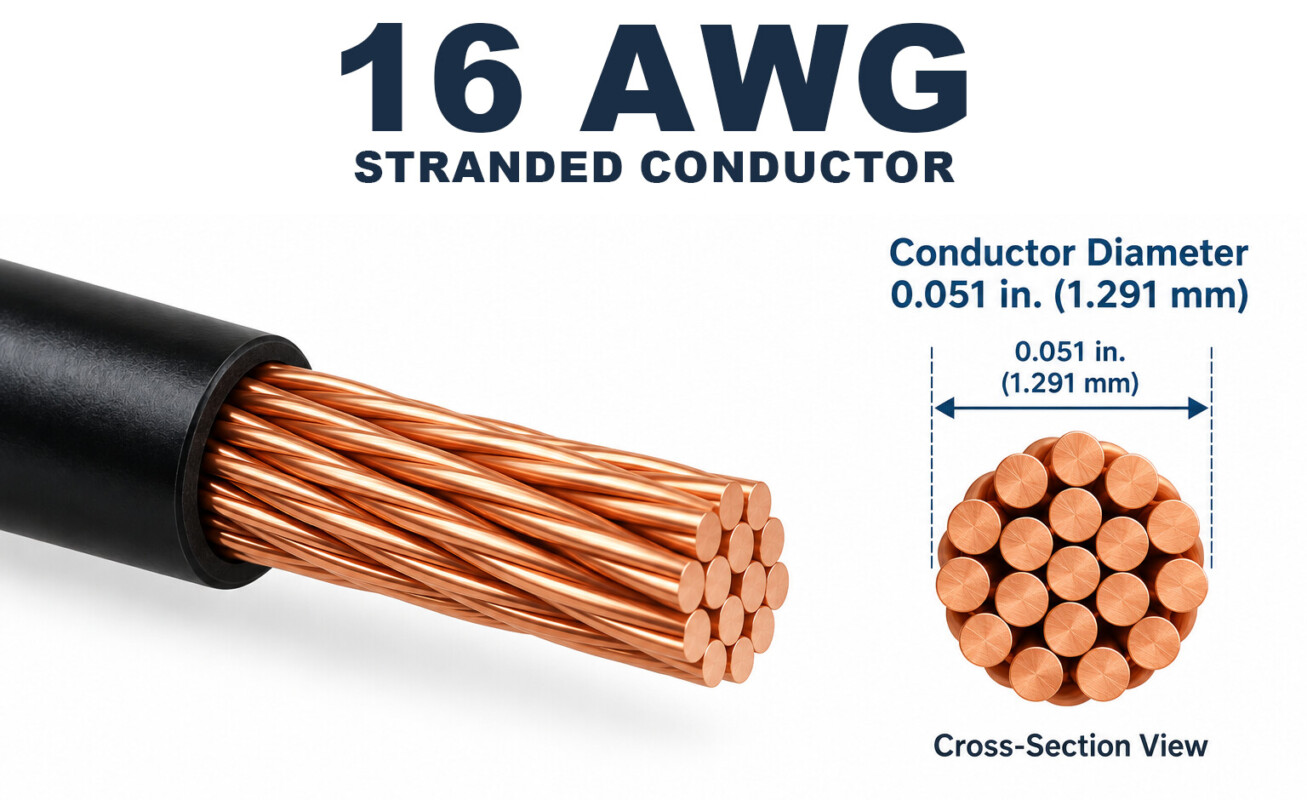 | Shorter runs, lower-wattage strips, tight conduit fill | ~15–25 ft per feed point |
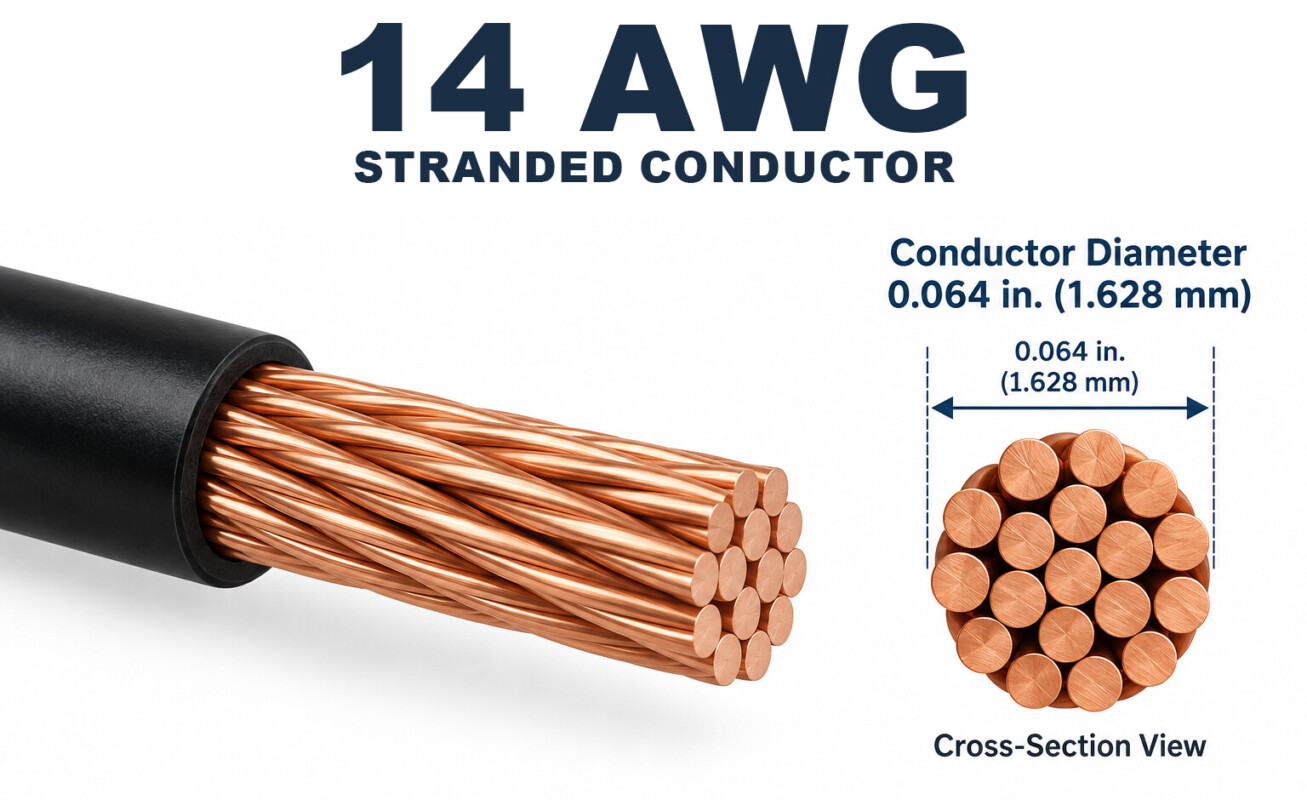 | Longer runs, higher-wattage loads, fewer power injection points | ~25–40 ft per feed point |
The practical upshot: 14 AWG buys you longer runs between power injection points, which on a large architectural job (cove lighting, facades, long hallway runs) can mean fewer transformers and pull points. 16 AWG is more than adequate for shorter, lower-draw runs and is easier to dress into a tight raceway or junction box.
Vertical Cable’s upcoming LED cable line covers both: the 213-146ST/5BK is a 14 AWG, 6-conductor CL3 cable on a 500 ft spool, and the 213-166ST/5BK is the 16 AWG, 6-conductor CL3 equivalent — same jacket and conductor count, sized for the shorter-run application.
Why 6-Conductor?
A 6-conductor LED cable isn’t overkill. It’s built for RGB+CCT (tunable white) fixtures, which need five signal conductors (red, green, blue, cool white, warm white) plus a shared positive. Running a single 6-conductor cable to a fixture location covers a full RGB+CCT circuit in one pull, instead of running a 2-conductor cable and a 4-conductor cable side by side. For single-color or basic RGB runs, the extra conductors give installers headroom for a future control upgrade without re-pulling cable.
CL3 vs. Direct Burial: Matching the Jacket to the Environment
CL3 – Interior Use | Direct Burial – In-Ground Use | |
CL3 cable is built and listed for interior use: in walls, ceilings, and risers, where the jacket doesn’t need to resist prolonged moisture or UV exposure. Installers sometimes use it as an outdoor conduit fill because it survives short excursions well, but it fails when run directly in soil, a standard CL3 jacket isn’t rated to resist continuous moisture intrusion, and it will eventually let water wick into the conductors. 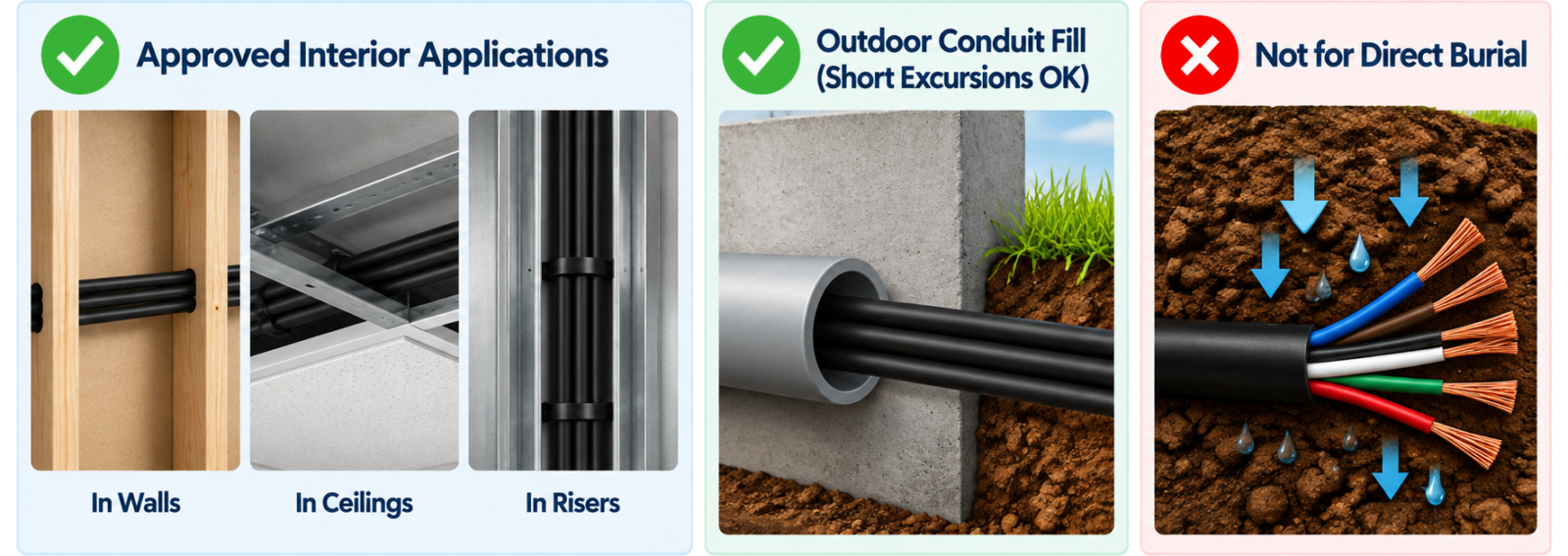 | Direct burial cable solves that with a jacket engineered to sit in wet soil indefinitely—typically a UV-resistant polyethylene jacket, often paired with water-blocking construction, so a nick in the outer jacket doesn’t turn into a wicking path down the whole run. Vertical Cable’s 213-146ST/DB/5BK is the direct-burial counterpart to the 14 AWG CL3. Same 14 AWG, 6-conductor, 500 ft spool format, built for landscape and exterior architectural LED runs that go straight into the ground rather than through conduit. 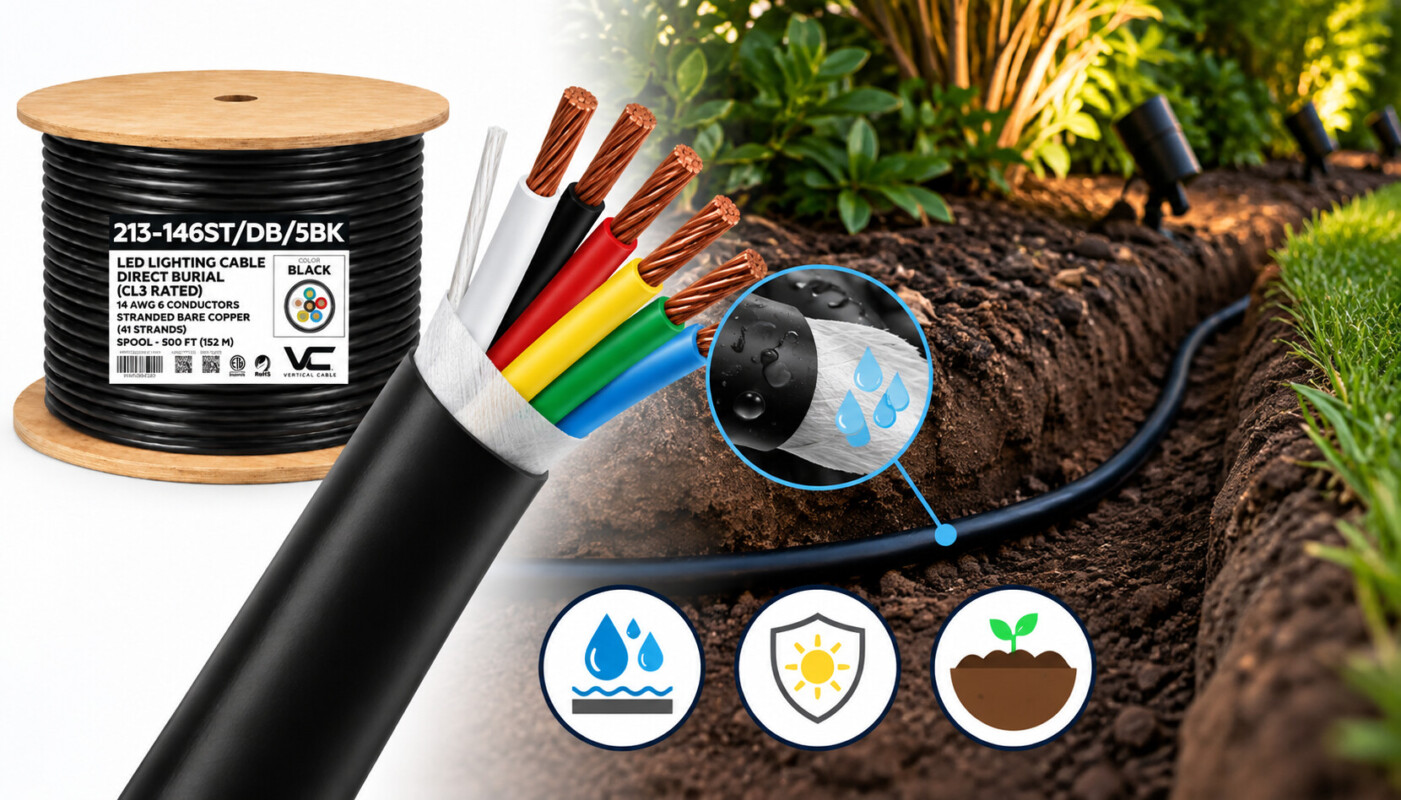 |
Question Decision Rule If the run stays inside the building envelope, walls, ceilings, plenum-adjacent spaces, use CL3. If any part of the run goes into soil, even briefly, use direct burial cable for that segment, or run CL3 inside conduit rated for wet locations. |
Installation Considerations
A few things worth confirming before you pull cable, regardless of which jacket you choose:
- Burial depth. Low-voltage landscape lighting circuits under 30V are commonly permitted at a shallower cover depth than standard direct burial cable under NEC Table 300.5, but depth requirements vary by voltage, location, and local amendment, always confirm the applicable depth with your local AHJ before trenching.
VERIFY: confirm current depth requirement with local code before quoting a specific number to a customer. - Separation from power wiring. Keep Class 2/3 low-voltage runs separate from line-voltage power circuits in the same trench or raceway unless you use a listed barrier, mixing them in the same conduit without separation is a common inspection failure.
- Listing markings. Confirm the cable jacket print shows the CL3 or direct burial listing you need before it goes in the wall or ground, once it’s closed up, checking becomes a demo job.
- Connector compatibility. Match connectors and splice hardware to the conductor gauge and count; a 6-conductor RGB+CCT run needs connectors rated for all six conductors, not adapted from a 2-conductor part.
Frequently Asked Questions
What gauge wire do I need for LED lighting?
It depends on running length and total wattage, not just personal preference. Shorter, lower-wattage runs are fine on 16 AWG; longer runs or higher-draw fixtures benefit from 14 AWG to keep voltage drop under 3% and avoid adding extra power injection points.
Can I use CL2 cable instead of CL3 for LED lighting?
CL2 is rated for lower voltage and power than CL3, and CL3 can substitute for CL2 in any application, but not the reverse. If the fixture manufacturer’s power source is Class 3, use CL3-rated cable to stay within the listing.
Is CL3 cable rated for outdoor or underground use?
No. Standard CL3 jacketing isn’t built to resist continuous moisture, and running it underground risks water intrusion into the conductors over time. Use a direct burial-rated cable for any run that goes into soil.
Why does 6-conductor cable matter for LED runs?
RGB+CCT (tunable white) fixtures need five independent signal conductors plus a shared positive, so a 6-conductor cable lets installers wire a full-featured fixture with a single pull instead of running two separate cables.
How far can I run 24V LED cable before I need power injection?
There’s no fixed number. It depends on total wattage and acceptable voltage drop, but as a general guide, 24V systems tolerate roughly twice the distance of 12V systems for the same load before dimming becomes noticeable.