
For most of the last two decades, backbone cabling was sized around a predictable load: people. Employees pulling files from a server room, streaming video to a desk, joining a call. Traffic moved north-south, out to the user, back to the core, in bursts that peaked at 9 a.m. and tapered off by 6.
AI is breaking that pattern, and it’s changing what “enough” backbone cabling looks like.
On a recent Fiber for Breakfast episode, Robin Olds, Senior Sales Business Development Manager at Cisco, put it plainly while discussing what it takes to build AI-ready networks: “AI introduces more east-west traffic.” Instead of a single user request bouncing to a server and back, AI workloads generate constant machine-to-machine communication: GPU clusters talking to edge nodes, edge nodes talking to the cloud, and model outputs feeding the next request before the last one’s even finished.
“Humans click, but agents swarm” — Robin Olds, Cisco, Fiber for Breakfast |
For installers and integrators, this isn’t an ISP problem to watch from the sidelines. It’s a backbone cabling problem, because backbone cabling is exactly where east-west traffic concentrates.
Why Backbone Cabling Takes the Hit First
Horizontal cabling runs from the telecommunications room to the work area; it’s built for north-south, user-facing traffic. Backbone cabling is different: it connects equipment rooms, telecommunications rooms, and entrance facilities to each other, per ANSI/TIA-568.3, the standard governing premises optical fiber cabling. In a typical building, that means the links between your main distribution area (MDA) and horizontal distribution areas (HDA), the switch-to-switch, MDF-to-IDF connections defined under ANSI/TIA-942.
That’s the exact path agentic AI traffic rides. When a chatbot model spiked, the spike showed up at the edge and faded. When an agentic workload runs continuously—gathering data, calling other systems, completing multi-step tasks without a human in the loop —that sustained load travels switch-to-switch, rack-to-rack, building-to-building. The horizontal cabling at the desk barely notices. The backbone does.
Copper or Fiber? Choosing Backbone Cabling Media for the New Traffic Profile
The fiber-vs-copper decision for backbone runs isn’t new, but the AI traffic profile tips the math.
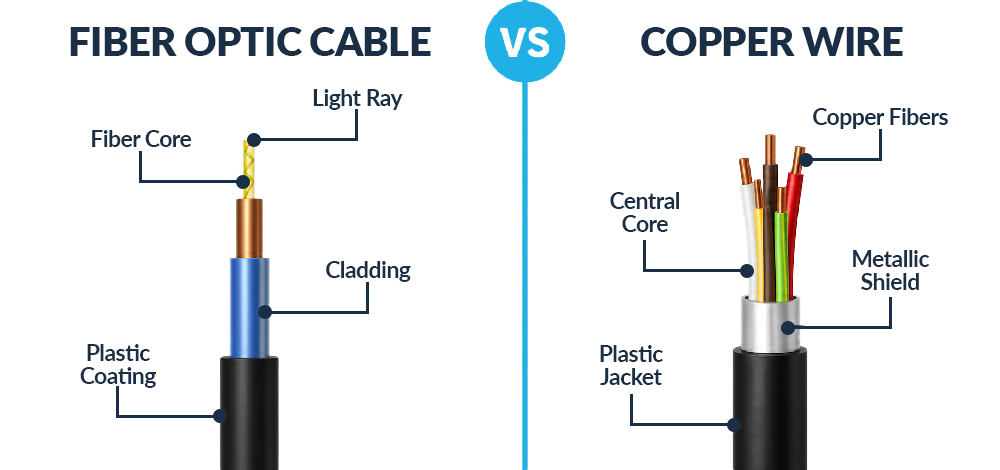
CAT6A copper still has a place for short, in-building backbone runs — MDF to an adjacent IDF, for example. IEEE 802.3an caps 10GBASE-T at a 100-meter channel over CAT6A (CAT6 drops to 55 meters at that speed), so for distances inside that envelope, a 23 AWG CAT6A backbone run is a legitimate, cost-effective choice.
Beyond 100 meters, or anywhere the building plan calls for headroom beyond 10G, fiber is the better bet, and fiber choice matters more than it used to. OM4 multimode handles 10 Gbps comfortably out to roughly 550 meters, but that distance shrinks quickly as speeds climb: 100GBASE-SR4 tops out around 100 meters on OM4, and 400G drops to about 50 meters. Singlemode (OS2), by contrast, supports everything from 1G to 400G+ on the same glass with nothing but a transceiver swap at each end. For backbone runs likely to see speed upgrades over their lifespan, which, given the AI trajectory, is most of them, that flexibility is worth the slightly higher per-meter material cost.
MEDIA | Best USE CASE | SPEED/DISTANCE |
|---|---|---|
CAT6A (23 AWG Copper) | Short, in-building backbone runs (MDF to adjacent IDF) | 10GBASE-T to 100 m (IEEE 802.3an); CAT6 drops to 55 m at 10G |
OM4 Multimode Fiber | Short, sub-100m, high-density runs where lower-cost transceivers offset shorter reach | ~550m at 10G; ~100 m at 100GBASE-SR4; ~50 m at 400G |
OS2 Singlemode Fiber | Backbone runs likely to see speed upgrades over their lifespan, most of them, given the AI trajectory | 1G to 400G+ on the same glass, transceiver swap only |
INSTALLER TIP Oversize the strand count. Backbone fiber cables are commonly pulled at 72 to 288 strands precisely because it’s cheaper to leave fiber dark now than to re-cable later when the next AI-driven bandwidth jump arrives. |
Designing for Persistent Load, Not Bursty Load
ANSI/BICSI 002 — DATA CENTER DESIGN PRACTICES Redundant, physically diverse backbone pathways. Cable management that supports fast fault isolation. Documentation thorough enough for the network team’s observability tools to use it |
That last point connects directly back to what Olds described: providers are leaning on automation and observability to catch congestion before customers notice it. None of that works if nobody can tell which backbone strand goes where. A clean, well-labeled backbone isn’t just good practice anymore; it’s part of the infrastructure that makes AI-driven network monitoring possible.
What This Means for Your Next Backbone Cabling Job
A few practical shifts worth building into bids and designs now:
- Pull more fiber than the current spec calls for. If the building has any AI-adjacent tenant — a healthcare practice running diagnostic models, an office deploying AI agents for document processing, anything with edge compute — the backbone that looked oversized two years ago may be tight today.
- Size pathways and conduit for growth, not just the current cable count. Re-pulling backbone fiber through an undersized sleeve is far more expensive than building in slack up front.
- Don’t assume CAT6A is overkill on short backbone runs just because the building’s current load doesn’t need 10G. East-west AI traffic is exactly the kind of demand that shows up after the cabling’s already in the wall.
- Document everything — strand counts, polarity, pathway routes — to the level a network engineer’s monitoring software can use. That documentation is becoming as much a part of the deliverable as the cable itself.
Frequently Asked Questions
What’s the difference between backbone cabling and horizontal cabling?
Backbone cabling connects telecommunications rooms, equipment rooms, and entrance facilities to each other — the building-to-building or floor-to-floor links. Horizontal cabling runs from a telecommunications room out to individual work areas. AI-driven east-west traffic concentrates on the backbone side because that’s where switch-to-switch and rack-to-rack communication happens.
What is backbone cabling in an enterprise?
In an enterprise network, backbone cabling is the subsystem linking the entrance facility, equipment rooms, and telecommunications rooms across floors or buildings — typically the MDF-to-IDF runs under ANSI/TIA-942. It’s usually a mix of fiber for longer or higher-speed links and copper for short, in-room connections. This subsystem takes the brunt of AI’s east-west traffic, since it carries switch-to-switch and server-to-server communication rather than traffic to an end-user desk.
What type of cable is used for backbone cabling?
Backbone cabling is run in copper or fiber depending on distance and speed needs. CAT6A UTP (23 AWG) handles 10GBASE-T to 100 meters under IEEE 802.3an and works well for short, in-building backbone runs. For anything longer, or any run that needs headroom past 10G, fiber — OM4 multimode or OS2 singlemode — is the standard choice.
What are the best cable types for AI data centers?
For most AI data center and edge-compute backbone runs, OS2 singlemode fiber is the safer long-term choice — it supports speeds from 1G up to 400G+ on the same glass with only a transceiver change, which matters as AI workloads keep pushing bandwidth needs higher. OM4 multimode still works well for short, sub-100-meter, high-density runs where the lower-cost transceivers offset its shorter reach at higher speeds. CAT6A copper rounds out the mix for short backbone hops where 10G is plenty.
How do you future-proof backbone cabling for AI workloads?
Three habits cover most of it: oversize the fiber strand count (backbone cables are commonly pulled at 72 to 288 strands so extra capacity can sit dark until it’s needed), favor singlemode fiber on any run that’s hard to access again, and size pathways and conduit for growth rather than the current cable count. Re-pulling backbone cabling after the fact costs far more than building in slack during the original install.
Building it ready for human traffic is a known job. Building it ready for AI’s east-west load is the one contractors should be quoting for now, not after the recable call comes in. If you have any questions or want to learn more about what’s happening at Vertical Cable, please contact us, and we hope to meet with you soon. |