
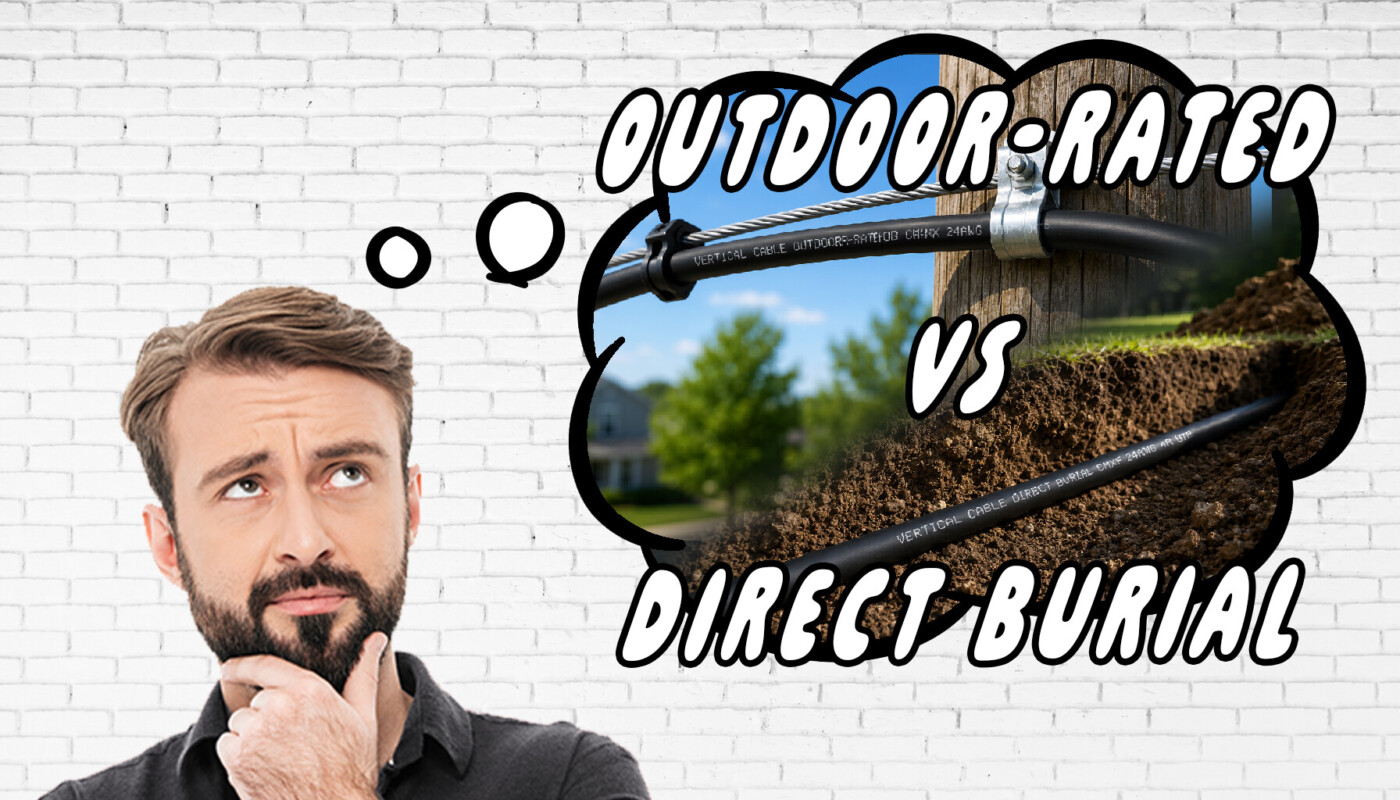
Direct burial vs. outdoor cable mix-ups cost installers money. An outdoor-rated cable pulled through wet soil without a water-blocking core doesn’t fail right away; it fails eighteen months later, when moisture finally wicks into the jacket. Both cable types survive outside the building envelope. However, they’re built for different exposure conditions. This guide breaks down the difference and helps you match the right construction to the job.
Quick Answer Outdoor-rated cable handles sun exposure, temperature swings, and moisture above ground, in aerial runs, exterior wall drops, and outdoor cable trays. Direct burial cable goes a step further: it adds a water-blocking gel-flooded or tape-flooded core, so installers can run it straight into the ground with no conduit required. Every direct burial cable qualifies as outdoor rated. Not every outdoor-rated cable qualifies for burial, though; skip the trench if the cable doesn’t have a flooded core. |
What Makes a Cable Direct Burial Rated
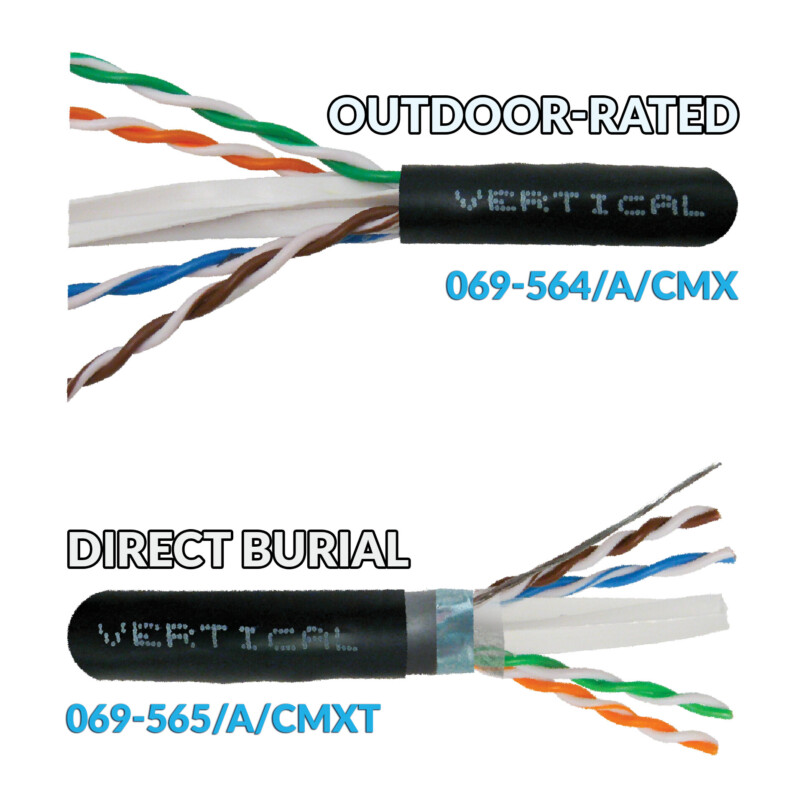
The defining feature of direct burial cable isn’t the outer jacket; it’s what’s inside. Direct burial constructions use a gel-flooded or tape-flooded core, a water-blocking compound packed around the conductors. This prevents moisture from wicking along the cable if the jacket is ever nicked underground. Without that flooding, groundwater travels along the cable path via capillary action, degrades the insulation, and eventually manifests as intermittent link errors or total signal loss.
Direct burial cable also uses a heavier, more abrasion-resistant outer jacket than standard indoor cable, since it must withstand direct soil contact, rocks, and freeze-thaw cycles over the life of the installation. Vertical Cable’s CAT6 direct burial line covers this with gel-flooded core UTP and F/UTP constructions, plus dual-jacket CMXT-rated options for installers who want extra mechanical protection over the flooded core. The same construction principle carries through the CAT6A and CAT5E lines.
“Direct burial” is an industry term, not a formal NEC listing category such as CMP or CMR. In most jurisdictions, unlisted outside-plant cable, including direct-burial cable, is permitted only 50 feet inside a building before it must terminate on a listed primary protector or transition to listed indoor cable, per NEC Article 800. Plan the entrance point and protector location accordingly.
What Makes a Cable Outdoor Rated
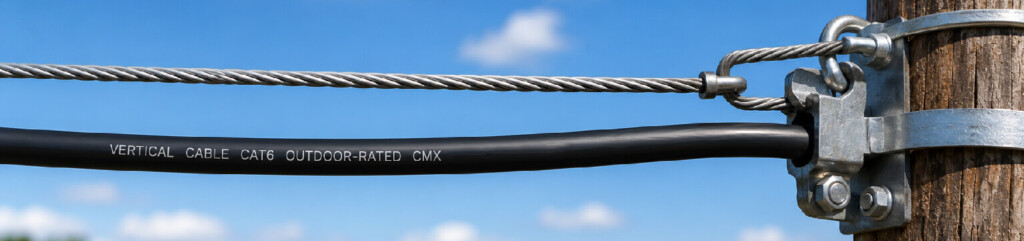
Outdoor-rated cable is built for UV and temperature resistance. It typically uses a UV-stabilized polyethylene (PE) jacket instead of the PVC used indoors, rated for a wider temperature range so it won’t crack in cold weather or degrade in constant sunlight. That’s enough for aerial spans, exterior building runs, cable trays, and drops that stay above ground and out of standing water.
What outdoor-rated cable usually skips is the flooded core. That keeps it lighter and easier to pull than direct burial cable, and it’s the right choice for aerial installations. Vertical Cable’s outdoor CAT6A, CAT6, and CAT5E lines cover this, with CAT6 and CAT5E offered with integrated steel messenger wire for pole-to-pole or building-to-building spans, where the messenger carries the mechanical load and the cable never touches the ground.
Running outdoor-rated cable without a flooded core underground is a gamble — you’re betting the jacket alone will keep moisture out indefinitely. That’s exactly the failure mode direct burial construction exists to prevent.
Direct Burial vs. Outdoor Cable at a Glance
 | OUTDOOR-RATED (AERIAL/EXPOSED) | DIRECT BURIAL |
|---|---|---|
Core Construction | Standard dry core | Gel- or tape-flooded, water-blocking |
Jacket | UV-resistant PE | UV-resistant PE, often heavier/dual-jacket |
Safe Underground? | No — moisture wicks along the core | Yes — designed for direct soil contact |
Typical Use | Aerial spans, exterior wall runs, messenger-supported drops | Underground runs without conduit |
Conduit Required? | Recommended if run below grade | Not required, but adds protection in rocky or high-traffic soil |
Example VC Lines | CAT6A Outdoor UV, CAT6/CAT5E Outdoor with Messenger | CAT6A/CAT6/CAT5E Direct Burial (CMXF/CMXT), direct burial fiber, audio, and security cable |
CAT6A, CAT6, and CAT5E Direct Burial and Outdoor Cable Options
Most of the volume in this category is Ethernet cable, and Vertical Cable’s twisted-pair lines split cleanly along the line above, across all three categories.
CAT6A Direct Burial & | CAT6 Direct Burial & | CAT5E Direct Burial & |
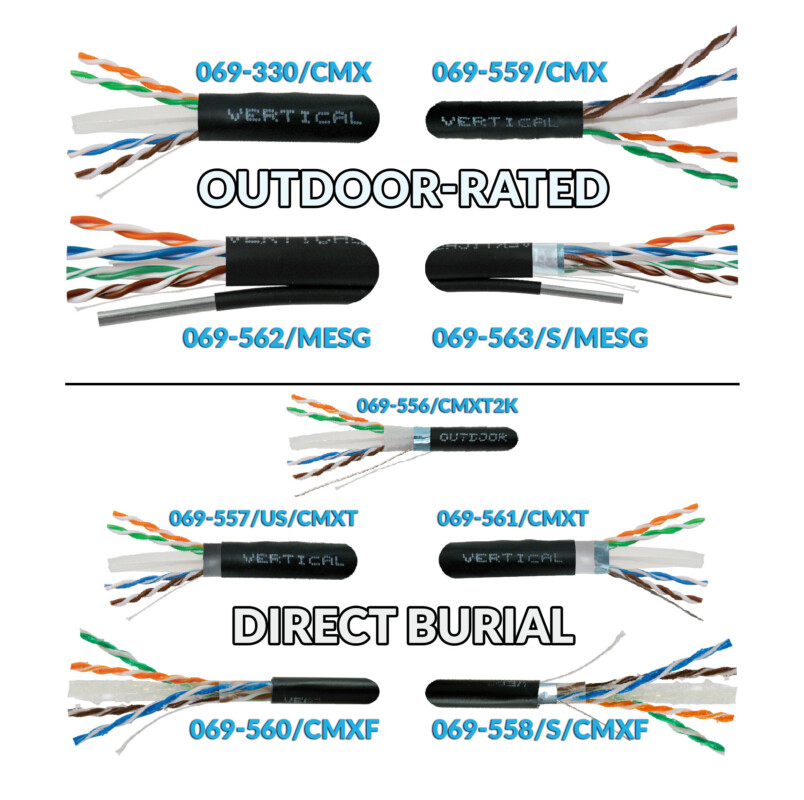
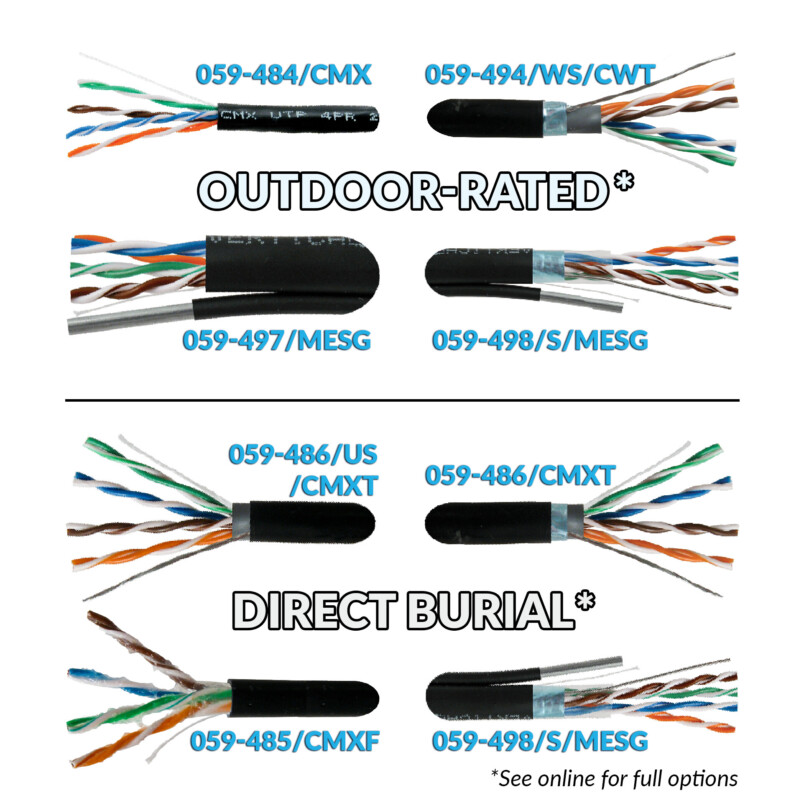
These outdoor lines are the right call for a camera run along a building exterior or a pole-to-pole aerial link, not for a trench.
Fiber, Audio, and Security Direct Burial Cable
Direct burial construction isn’t limited to Ethernet cables; the same gel-flooded principle applies anywhere a run must go underground. Vertical Cable’s bulk fiber optic cable line includes direct burial-rated constructions for campus and building-to-building backbone runs, where trenching is more practical than aerial fiber. The same logic extends to low-voltage audio and security cable. Vertical Cable’s direct burial audio cable comes in 12, 14, 16, and 18 AWG gauges, including high-strand variants for better flex life during longer pulls. Installers use it for landscape audio, distributed speaker runs, and outdoor paging systems that cross open ground between structures. Direct burial security cable is available in 18 AWG and 22 AWG, shielded and unshielded, for buried runs to gate access controllers, perimeter cameras, and outdoor sensors. In both categories, look for the “DB” designation on the part number; that signals the core is flooded and the cable is rated for a trench. | 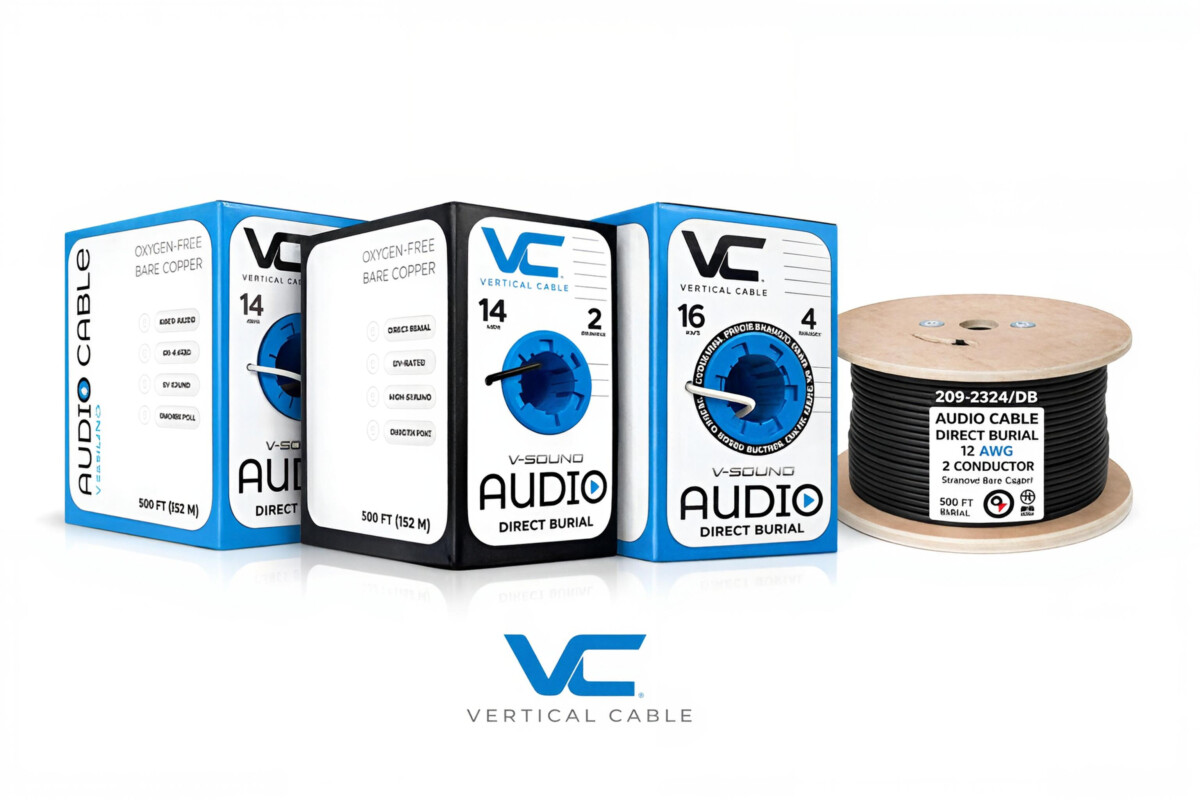 |
Which One Do You Need?
Start with one question: does any part of this run touch the ground, or does it stay in the air or against a wall?
If the cable stays aerial, wall-mounted, or otherwise above grade and out of standing water, outdoor-rated cable, with a messenger for any real distance, is the lighter, easier-to-pull, and less expensive option. There’s no reason to pay for a flooded core you don’t need.
If any part of the run goes into a trench, conduit, or direct soil contact, spec direct burial cable, full stop. The cost difference between direct burial and standard outdoor cable is small compared to the cost of digging up a failed run two years later.
Burial Depth and the NEC 50-Foot Rule
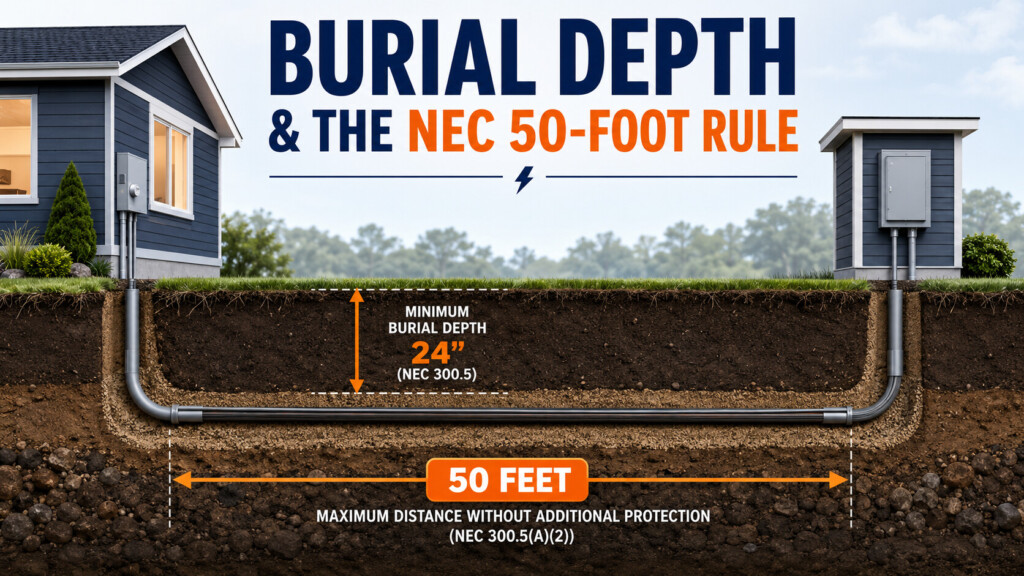
The NEC doesn’t publish a minimum cover depth table for Chapter 8 communications cable the way it does for power circuits, so there isn’t one universal number. Check with your local AHJ, since some jurisdictions set their own minimums. As a practical baseline, most installers won’t go shallower than 6 inches, and many target 12 to 24 inches for cable that isn’t in conduit, both to clear the frost line and to reduce the risk of landscaping or future digging.
Conduit isn’t required for a properly rated direct burial cable. That said, it provides real protection in rocky soil or anywhere the run crosses under a driveway or in a high-traffic area. Whatever depth you land on, remember the entrance-point rule: direct burial and other unlisted outside-plant cable must be routed 50 feet inside the building before it can terminate or transition to a listed cable type.
Frequently Asked Questions
What is the difference between direct burial and outdoor Ethernet cable?
Outdoor Ethernet cable has a UV-resistant jacket for aerial or exposed above-ground runs, but typically a standard dry core. Direct burial Ethernet cable adds a gel- or tape-flooded core that blocks water from wicking along the cable; that’s what makes it safe to bury without conduit.
Is CAT6 rated for direct burial?
Standard indoor CAT6 is not. It needs the gel-flooded core and heavier jacket of direct-burial construction to survive underground. Vertical Cable’s CAT6 direct burial line is built specifically for this, in gel-flooded UTP and F/UTP with optional dual-jacket protection; the same construction is available in CAT6A and CAT5E.
Does direct burial cable have to be in conduit?
No. Direct burial cable is engineered for burial without conduit. Conduit is still a good idea in rocky soil, under driveways, or anywhere the cable is likely to be disturbed by future digging, but it isn’t required.
What is the NEC code for direct burial cable?
NEC Article 800 governs communications circuits, including outside plant and direct-burial cable, but it doesn’t assign direct-burial cable a specific listing category as CMP, CMR, and CM are defined. “Direct burial” is an industry construction standard built around a flooded core. The relevant NEC requirement to plan around is the 50-foot allowance for unlisted outside plant cable entering a building before it must terminate or transition to listed cable.
Can direct burial cable be used outdoors?
Yes. Every direct burial cable is also suitable for above-ground outdoor use, since it’s built with the same UV-resistant jacketing as standard outdoor cable and a flooded core. The reverse isn’t true, standard outdoor-rated cable without a flooded core shouldn’t be buried.
Shop Outdoor-Rated & Direct Burial Cables Outdoor-rated and direct burial cable both survive outside the building. Only one of them survives inside the dirt. If any part of the run goes underground, spec the flooded core. For everything that stays above grade, standard outdoor cable, with a messenger for aerial spans, does the job for less. For OSP design details beyond a single run, ANSI/TIA-758 is the standard that governs customer-owned outside plant cabling, pathways, and spaces. |