
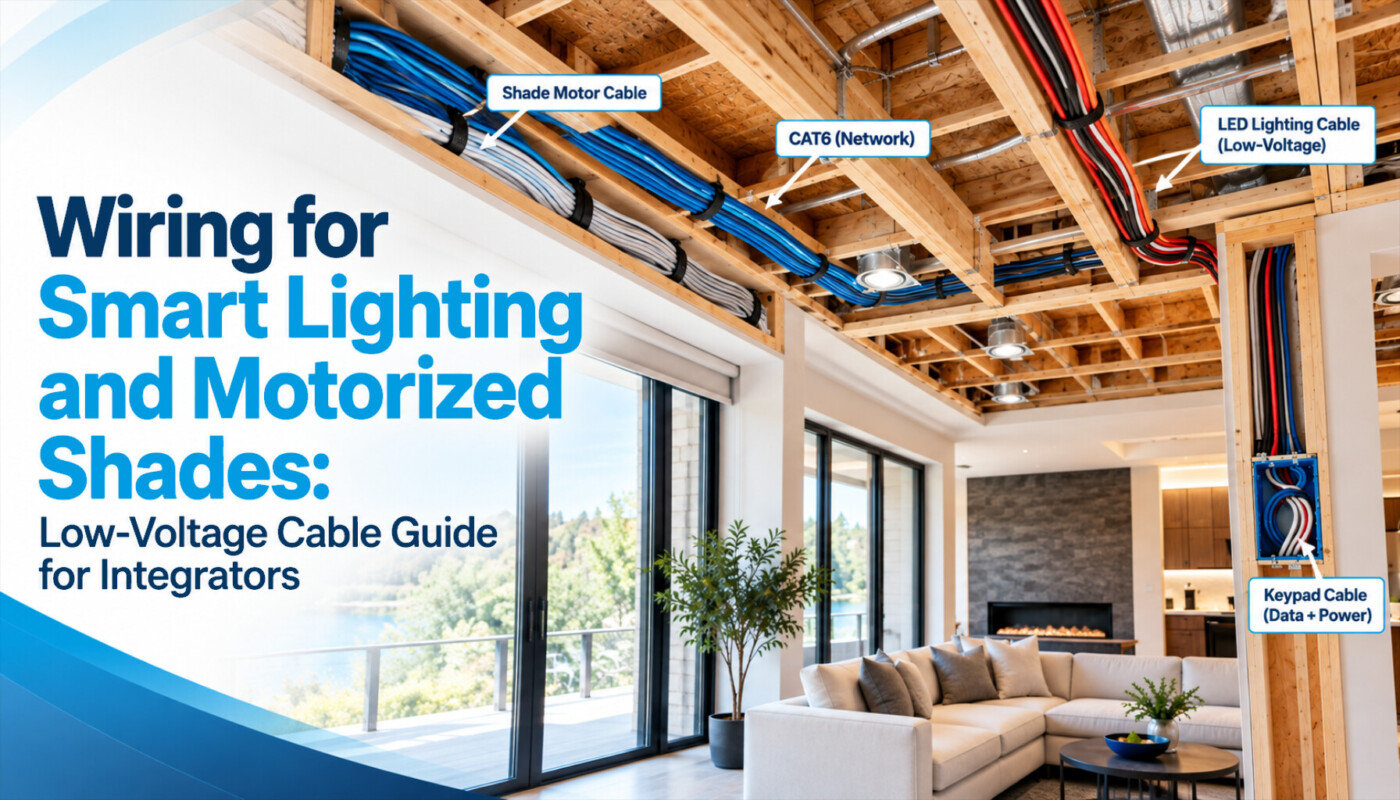
Smart lighting and motorized shades are where residential integration is growing fastest, and both live or die at rough-in. Keypads, lighting control buses, low-voltage lighting wire runs, and shade motors each need a specific cable pulled to the right place before drywall. Get it wrong, and the fix means cutting open a finished ceiling.
This guide walks through the cable side of a lighting and shading project by function: control and keypad wiring, low-voltage lighting runs, shade power and data, network connections, and the jacket ratings each run needs. It is written to be manufacturer-neutral, so always check the wiring requirements of the specific system you are installing.
Why Lighting and Shades Are Driving 2026 Projects
CEDIA’s 2026 Professional Smart Home Market Analysis, presented at CEDIA Expo in September, ranked lighting as the leading growth opportunity for integrators, with shades and home automation also in the top five. The same research found networking is the most widely installed technology, reported by 88% of integrators surveyed.
Those categories overlap at rough-in. A single room might need a keypad, a lighting control bus, a low-voltage fixture run, two shade motors, and a network drop for a controller, all pulled in the same visit. That is why the pre-wire plan, not the device list, decides whether the project goes smoothly.
Planning the Pre-Wire: Home Runs vs. Bus Topologies
Every lighting and shading system uses one of two wiring approaches, and many projects use both.
HOME RUN (STAR) | BUS (DAISY-CHAIN OR FREE TOPOLOGY) | |
|---|---|---|
How It Works | Each device gets its own cable back to a central panel or equipment location. | Devices share one communication cable that runs from device to device. |
Typical Uses | Shade motors, low-voltage fixture circuits, networked controllers, PoE devices. | Keypads and control modules on a lighting control bus. |
Advantages | Easy to troubleshoot, re-zone, and expand. One failed run affects one device. | Less cable and fewer pulls; simple to add devices along the route. |
Watch For | More cable and more space at the head end. | Some buses must be daisy-chained with no branches; others allow free topology. One damaged segment can affect everything downstream. |
WHEN IN DOUBT, HOME-RUN IT If the system allows either approach, home-run shades and fixture circuits to the equipment location. The extra cable costs far less than tracing a fault through a finished wall, and it keeps the system flexible when the homeowner wants to re-zone later. |
Cable for Keypads and Lighting Control
Lighting control keypads and modules typically communicate over a low-voltage bus that carries both data and power. Many residential systems specify a four-conductor composite cable for this: a shielded, twisted 22 AWG data pair plus a heavier 16 or 18 AWG power pair in one jacket. Vertical Cable’s control cable line includes both constructions, 22/2 shielded + 16/2 and 22/2 shielded + 18/2.
Choose between the two by the power load and length of the bus. Longer buses and more devices draw more current, which favors the 16 AWG power pair. Always follow the lighting system manufacturer’s specified cable type, maximum bus length, and device count.
KNX and Other Open-Protocol Buses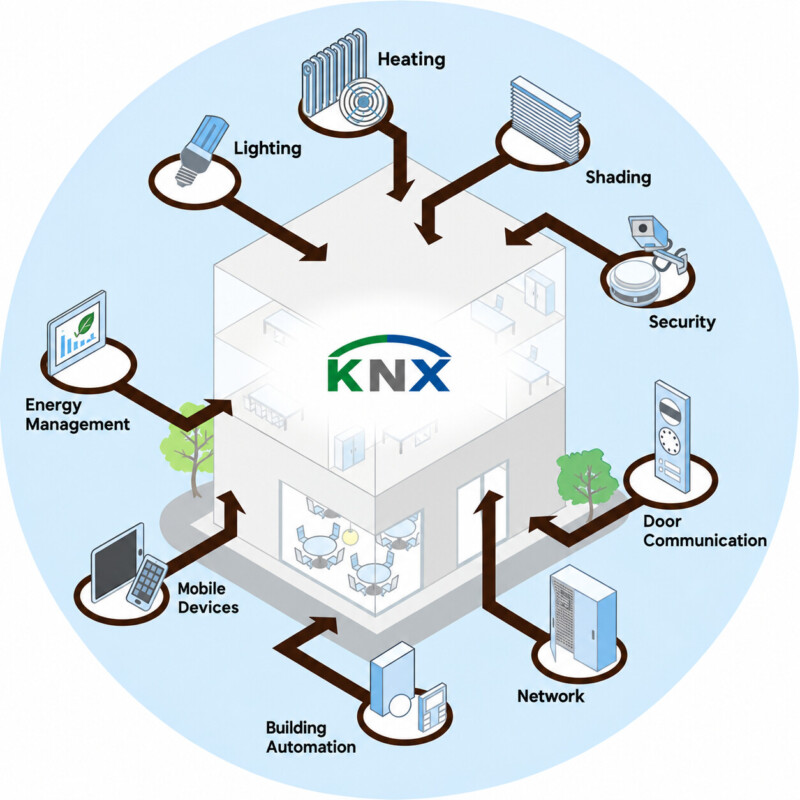 Open-protocol systems such as KNX define their own bus cable. The standard KNX TP1 cable is a green, shielded two-pair cable with 0.8 mm solid conductors, and each line segment supports up to 1,000 meters of cable and 64 devices. In U.S. installations, also confirm the cable carries the NEC listing the space requires, such as CL2 or riser-rated, since some bus cable is built to European standards only. | Networked Lighting Controllers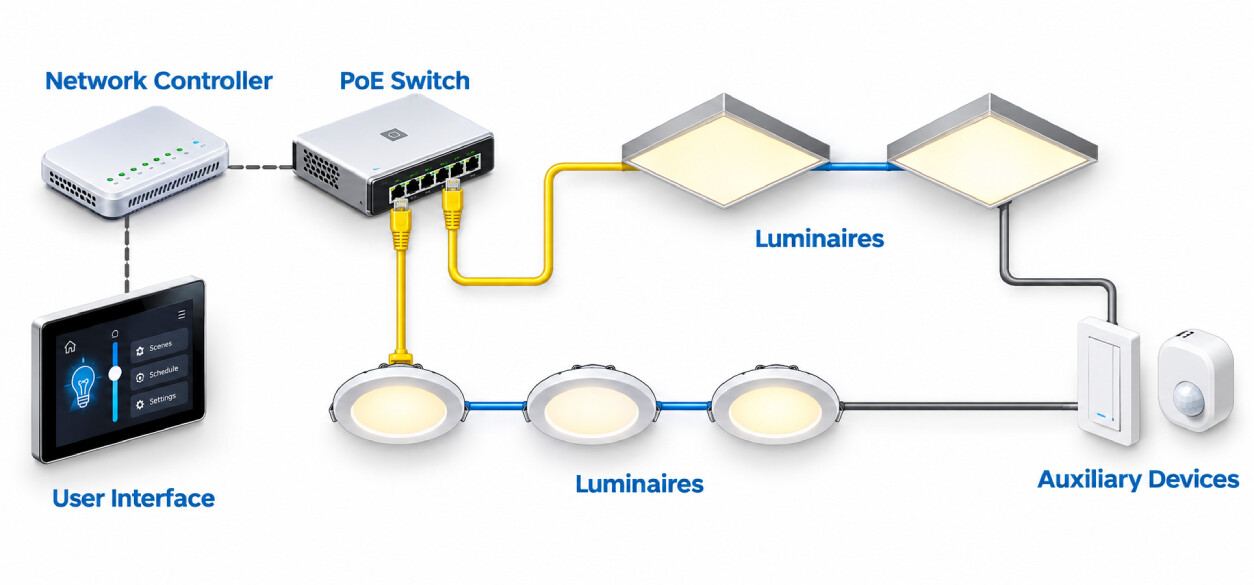 Lighting processors, gateways, and hubs need a network drop at the equipment location, and some keypads and touchscreens are network devices themselves. Pull CAT6 to every controller location and to any keypad position that might become a touchscreen later. |
Low-Voltage Lighting Wire: Runs and Gauge Selection
Low-voltage LED fixtures, tape light, and landscape lighting run on 12 V or 24 V power from a driver or transformer. At those voltages, current is high relative to the power delivered, so voltage drop becomes the main sizing concern. Too much drop shows up as dim fixtures at the end of the run or color shift on RGB and tunable-white products.
A practical design target is 3% voltage drop or less. The table below shows the approximate maximum one-way run per amp of load at that limit, based on standard copper resistance. Divide by the load in amps to get the maximum run for your circuit.
WIRE GAUGE | 24 V DC (PER AMP) | 12 V DC (PER AMP) | EXAMPLE: 24 V, 2.5 A LOAD |
|---|---|---|---|
18 AWG | 56 ft. | 28 ft. | 22 ft. |
16 AWG | 90 ft. | 45 ft. | 36 ft. |
14 AWG | 143 ft. | 71 ft. | 57 ft. |
12 AWG | 227 ft. | 113 ft. | 91 ft. |
Two takeaways stand out. A 24 V system reaches twice as far as 12 V on the same wire, and moving up one gauge buys roughly 60% more distance. For long runs, place the driver closer to the fixtures, split the load across multiple runs, or step up to heavier wire.
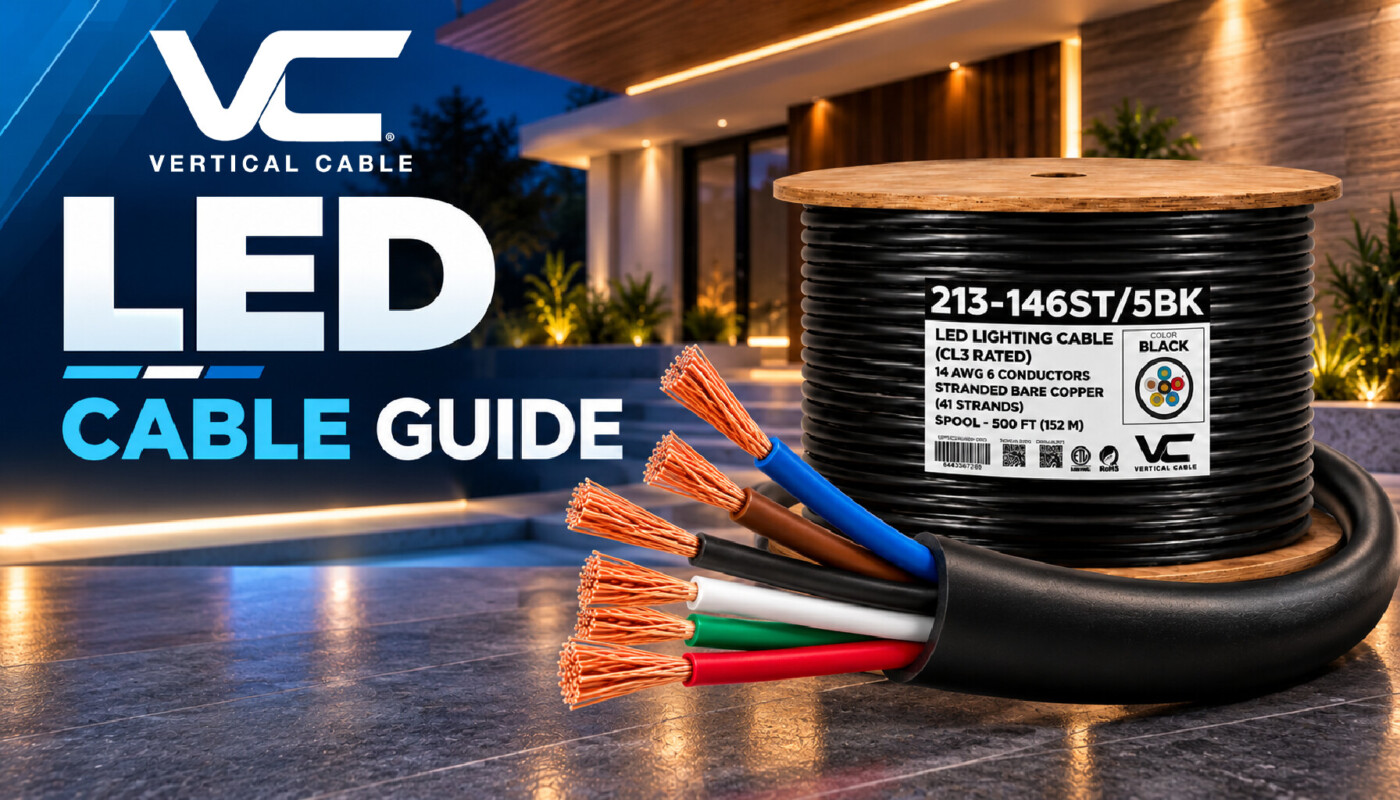
Vertical Cable’s six-conductor LED cable covers the common sizes: the 213-146ST/5BK (14 AWG, CL3), the 213-166ST/5BK (16 AWG, CL3), and the 213-146ST/DB/5BK (14 AWG, direct burial). Six color-coded conductors handle multi-zone runs and RGB+W or tunable-white fixtures in one cable.
PoE LightingPoE lighting powers and controls fixtures over standard category cable, with each fixture home-run to a PoE switch. IEEE 802.3bt allows up to 90 W at the switch port, which is enough for most residential fixtures. Because high-power PoE heats cable in large bundles, use solid-copper CAT6A for dense lighting runs and keep bundle sizes within code limits. 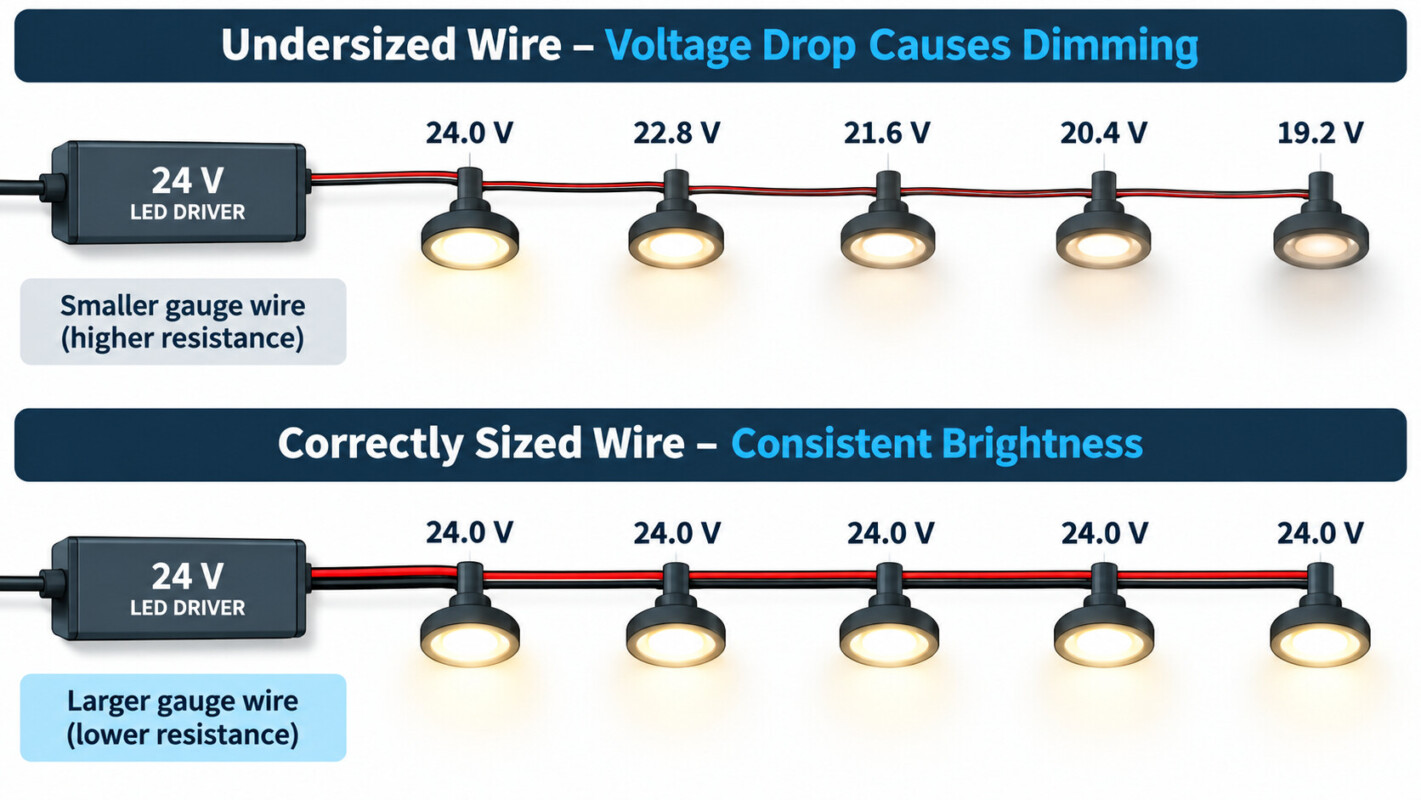 |
Shade Power and Data Wiring
Motorized shades come in several power types, and each one changes the rough-in:
- Low-voltage wired shades take DC power, often 24 V, from a central power panel, plus data on a bus or dedicated pair. These are the integrator’s cable, typically a multi-conductor cable or a composite power-and-data cable home-run to the panel.
- Line-voltage shades run on 120 V and are wired by an electrician with standard building wire. Low-voltage cable may still be needed for a separate control connection.
- PoE shades take power and data from a PoE switch over category cable, home-run like any other network device.
- Battery-powered shades need no power wiring, which makes them common in retrofits. Pulling cable anyway during new construction keeps the option open.
Whatever the type, the most important decision is location. Pull the cable to the window head on the side where the motor will sit. If the motor side is not decided yet, leave enough slack to reach either end of the headrail, coil it neatly, and label it with the room and window.
SHADE PRE-WIRE CHECKLIST
|
Jacket Ratings for Low-Voltage Lighting Wire and Shade Cable
Most lighting control, LED, and shade circuits are Class 2 or Class 3 power-limited circuits under NFPA 70, so the cable must carry the matching listing for where it is installed.
LOCATION | REQUIRED RATING | VERTICAL CABLE OPTIONS |
|---|---|---|
In Walls and Ceilings | CL2 or Cl3 (CL3 substitues for CL2) | |
Risers between Floors | CL2R or CL3R | |
Plenum Air Spaces | CL2P or CL3P | |
Underground (Landscape) | Direct Burial Rated |
Outdoor landscape lighting adds its own rules. Low-voltage landscape circuits often allow shallower burial depth than other cable, but requirements vary by voltage and jurisdiction, so confirm with the local authority having jurisdiction before trenching. Any segment that goes into soil should be direct burial rated or installed in conduit rated for wet locations.
Frequently Asked Questions
What wire do I need for low-voltage lighting?
Most low-voltage LED and landscape lighting uses 12 to 16 AWG stranded copper cable rated for the location: CL2 or CL3 inside walls and direct burial rated underground. Size the gauge for voltage drop, keeping the drop at about 3% or less over the run length and load.
What cable do lighting control keypads use?
Many systems use a four-conductor composite cable with a shielded 22 AWG data pair and a 16 or 18 AWG power pair. Requirements vary by manufacturer, so confirm the specified cable, maximum bus length, and topology for the system you are installing.
What is PoE lighting?
PoE lighting delivers both power and control to LED fixtures over Ethernet cable from a PoE switch. Each fixture is home-run to the switch, and high-power PoE allows up to 90 W per port under IEEE 802.3bt.
Can I use CAT6 instead of KNX cable?
It is not recommended. KNX cable limits for line length, device spacing, and device count are based on the electrical characteristics of certified KNX bus cable. Use cable certified for KNX, and confirm it also carries the NEC listing the installation location requires.
What wire do motorized shades need?
It depends on the shade type. Low-voltage wired shades typically need a multi-conductor or composite power-and-data cable home-run to a power panel, PoE shades need category cable, and line-voltage shades are wired by an electrician. Battery shades need no power wiring.
WIRING A LIGHTING AND SHADING PROJECT? Vertical Cable stocks LED cable, control cable, CAT6 and CAT6A, and direct burial options for every part of a smart lighting and shading install. Not A Vertical Cable Distributor Yet? Apply For An Account And Our Team Will Get You Set Up. |