
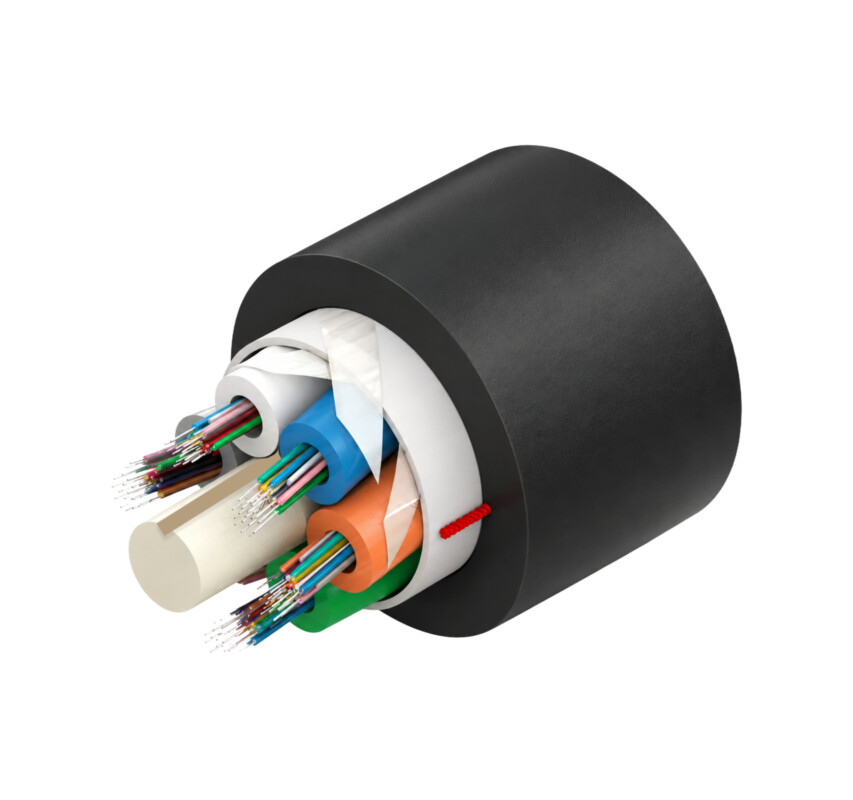
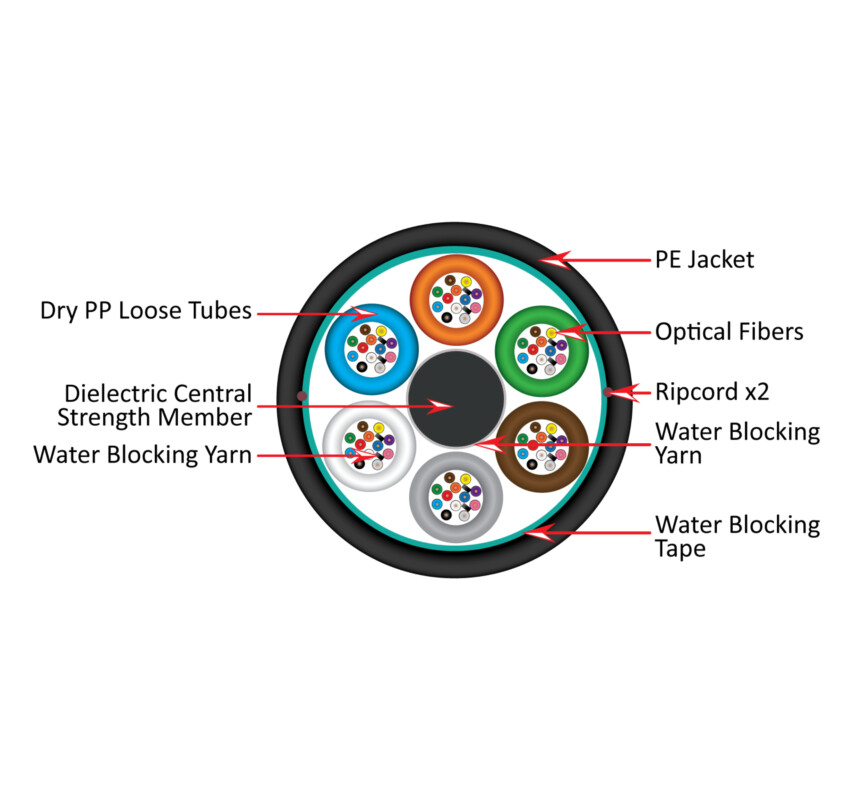


VERTICAL CABLE 281-NAR SERIES – LOOSE TUBE OPTICAL FIBER CABLE (SINGLEMODE, ALL-DIELECTRIC, NON-ARMORED)
The 281-NAR Series is a family of all-dielectric, non-armored loose-tube optical fiber cables built for outside plant routes. It comes in 6 to 144 singlemode fibers, with a dry, gel-free design that keeps splicing clean and a black polyethylene jacket that resists water and UV. Made for duct, lashed aerial, and air-blown installations, this loose tube optical fiber cable has no metal in its construction, so the cable itself needs no bonding or grounding.
KEY FEATURES
Here’s what makes the 281-NAR Series a dependable loose tube optical fiber cable:
- All-Dielectric Construction: An FRP central strength member and no metal in the cable, so it’s nonconductive.
- Dry, Gel-Free Loose Tubes: Flexible polypropylene tubes with water-blocking yarn and tape, with no gel to clean up before splicing.
- 6 to 144 Fibers: Seven fiber counts (6, 12, 24, 48, 72, 96, and 144) cover most outside plant builds.
- Singlemode G.652.D Fiber: Max attenuation of 0.36 dB/km at 1310 nm and 0.25 dB/km at 1550 nm.
- Color-Coded Fibers: 12-color fiber identification, with 2 to 12 fibers per tube.
- Water-Blocking, UV-Resistant Jacket: Black polyethylene jacket made for outdoor exposure.
- Easy Stripping: Two aramid ripcords make jacket removal simple.
- Compact Size: 0.44 in (11.1 mm) outer diameter up to 72 fibers, 0.5 in for 96 fibers, and 0.63 in for 144 fibers.
- Strong and Crush Resistant: 890 N long-term and 2,700 N short-term tensile strength, plus 2,200 N/100 mm short-term crush resistance.
- Wide Temperature Range: Operates from -40°C to 70°C and installs from -30°C to 70°C.
APPLICATIONS
The 281-NAR Series is made for outside plant installations:
- Duct Installations: Pull into underground conduit and duct runs.
- Lashed Aerial Installations: Lash to a messenger strand along pole lines.
- Air-Blown Fiber Installations: A compact cable that suits blown-fiber deployments.
- Telecom and Campus Backbones: Long singlemode links between buildings, nodes, and equipment rooms.
- FTTx Feeder and Distribution: A range of fiber counts for building out access networks.
WHY CHOOSE THE 281-NAR SERIES LOOSE TUBE OPTICAL FIBER CABLE?
Professionals choose the 281-NAR Series for its dry design, compact size, and wide range of fiber counts. Here are 5 reasons to specify it for your next project:
- Gel-Free and Clean: Dry loose tubes mean no gel to clean off before splicing.
- No Metal, No Grounding: The all-dielectric construction makes the cable nonconductive.
- Seven Fiber Counts: Choose from 6 to 144 fibers in the same cable family.
- Compact and Flexible: A small diameter and up to 72 fibers make it easier to pull into a duct or lash to a strand.
- Built for Outdoor Conditions: A water-blocking, UV-resistant jacket and a wide temperature range stand up to exposed routes.
GETTING IT INSTALLED?
Once you’ve picked your 281-NAR configuration, here’s what to keep in mind:
- Match the cable to the pathway. This cable is for duct, lashed aerial, and air-blown routes. For direct-buried runs, an armored cable is the usual choice.
- Watch bend radius and pulling tension. Keep bends at 20x the cable diameter during the pull, which is roughly 9 in for the 0.44 in cable and about 12.6 in for 144 fibers. Stay under 2,700 N during installation and 890 N once installed.
- Plan the building entrance. This is outside plant cable, not plenum- or riser-rated. NEC 770.48 generally limits unlisted OSP cable to 50 ft past the point of entrance, ending in an enclosure, so plan a splice to listed indoor cable there.
- Respect the installation temperature. Install between -30°C and 70°C (-22°F to 158°F).
- Keep a splice map. With up to 12 colored tubes and 12 fiber colors per tube, label and record each splice as you go.
For premium fiber cabling solutions, visit Bulk Optical Fiber Cable to discover top-tier options today!


