

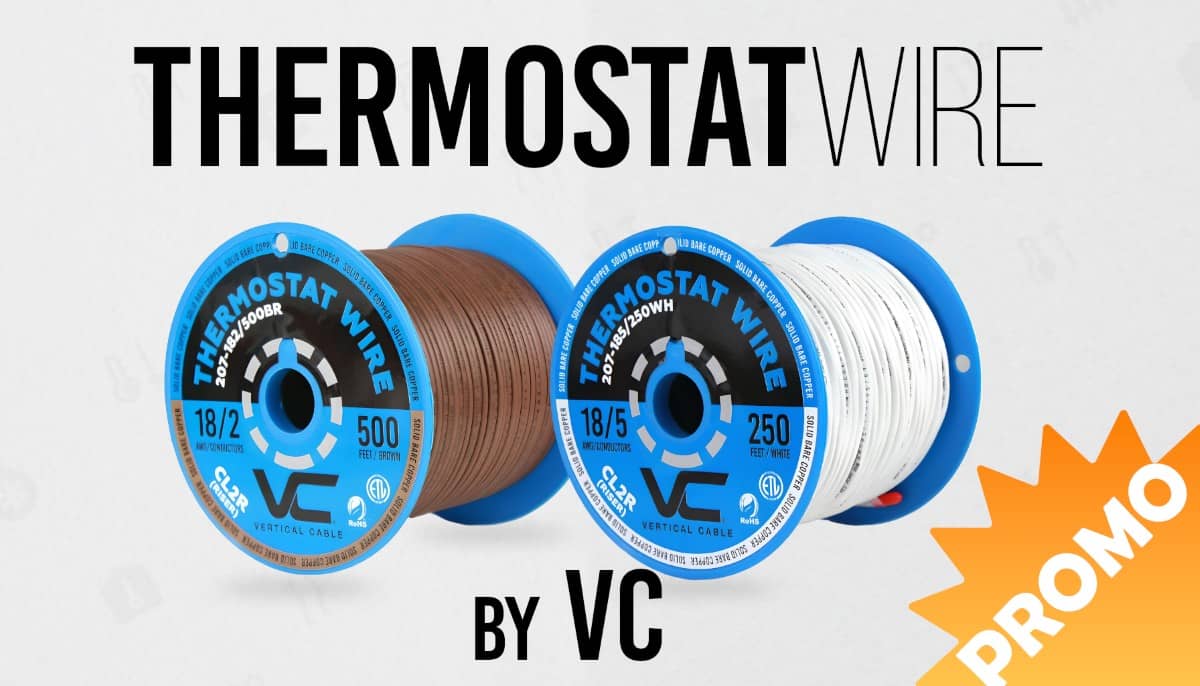
Vertical Cable’s new thermostat wire is designed for low-voltage applications in HVAC and other environmental control systems. Available in white and brown, configurations, and gauges, our thermostat wire is versatile and reliable, making it an ideal choice for professional installers.
Features & Specifications
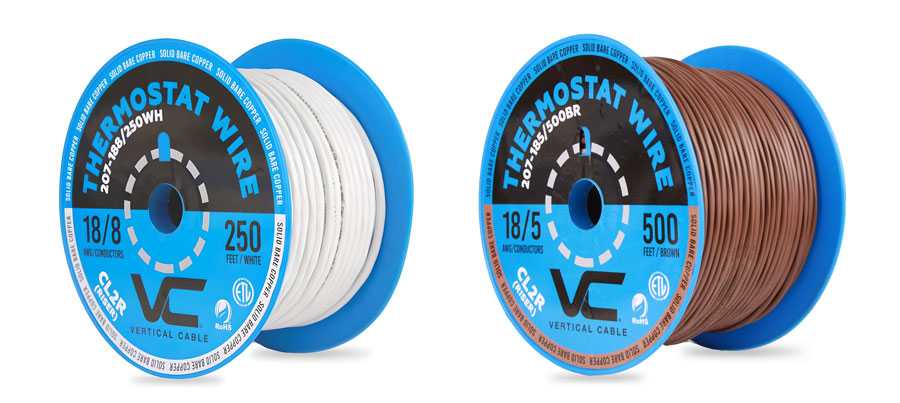
Color Options: Available in White and Brown for easy identification and aesthetic flexibility in residential or commercial settings.
Spool Type: Supplied on a Plastic Spool for smooth, tangle-free dispensing, saving time during installation.
Material: Constructed with Solid Bare Copper conductors for superior conductivity, ensuring efficient signal transmission and reduced energy loss over long distances.
Safety Ratings: Available in both CL2R (Riser) and CL2P (Plenum) options to meet fire safety requirements. The CL2R rating is for installations in risers or vertical spaces, while CL2P (Plenum) rated wire is suitable for use in air-handling spaces where stricter fire codes apply.
Gauge & Conductors: Available in 18-20 AWG, with configurations from 2 to 8 Conductors. This variety supports systems with differing power and control needs, whether it’s a simple single-zone thermostat or a more complex multi-zone HVAC system.
Certifications: ETL Listed and RoHS Compliant, ensuring compliance with safety and environmental standards.
Applications
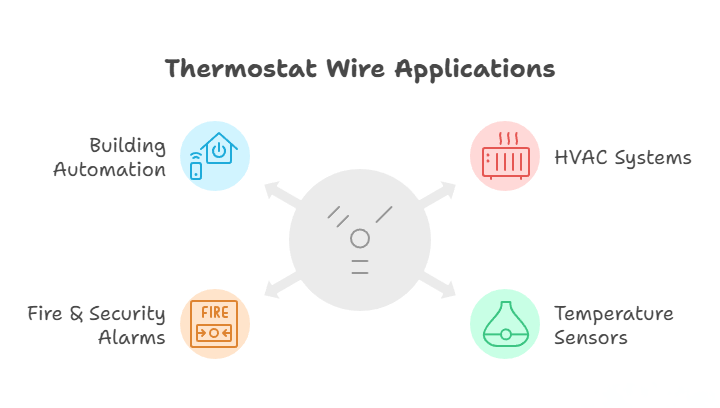
Thermostat wire is commonly used in the following applications:
- HVAC Systems: For connecting thermostats to heating and cooling units, controlling temperature settings and fan functions.
- Temperature Sensors: Used to relay information from sensors to central control units in smart home systems.
- Fire & Security Alarm Systems: Certain thermostat wires can also be used in low-voltage alarm installations.
- Building Automation: Suitable for broader environmental control systems, including automated ventilation and energy management.
Benefits of Using Vertical Cable Thermostat Wire
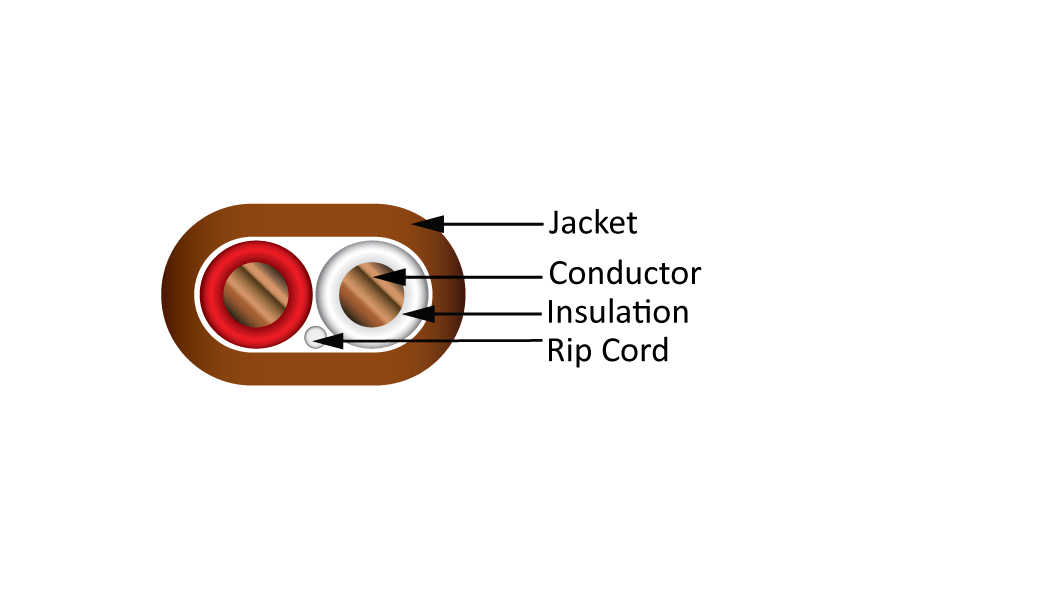
- Durability: The solid bare copper core and sturdy insulation offer excellent wear resistance, extending the life of your installations.
- Flexibility: With multiple conductor options, our thermostat wire can handle everything from basic thermostat functions to complex, multi-zone systems.
- Safety: The choice of riser or plenum-rated wire ensures compliance with building codes and enhances fire safety in both residential and commercial applications.
- Ease of Installation: The plastic spool makes dispensing easy, while the solid copper core allows for straightforward, stable connections.
- Environmental Responsibility: RoHS compliance guarantees that the product is free from harmful substances, making it a safer choice for the environment.
Packaging
All 250 ft spools come in a master box of four spools.
Specs can be found here: THERMOSTAT WIRE by Vertical Cable.
Limited-Time Thermostat Wire Promotion
Take advantage of Vertical Cable’s Thermostat Wire Promotion — available November 1 – November 26!
This offer covers our complete lineup of 18 AWG and 20 AWG thermostat wire (3 to 8 conductors), CL2R (Riser) and CL2P (Plenum) rated, featuring solid bare copper construction for reliable performance in residential and commercial HVAC systems.
Available in white and brown finishes.
Promo Details
- Orders over $1,000 — 8% Discount
- Orders under $1,000 — 5% Discount
Now’s the perfect time to stock up on professional-grade thermostat wire — durable, flexible, and easy to install.
Frequently Asked Questions About Thermostat Wire
What kind of wire is used for thermostats?
Thermostat wire is typically 18 AWG low-voltage solid copper wire used for HVAC control applications. The most common configurations include 18/2 (2-conductor), 18/5 (5-conductor), and 18/8 (8-conductor) thermostat wire. The wire gauge refers to the thickness of the conductor, with 18 AWG being the industry standard for most residential and commercial thermostat installations. These low-voltage wires operate at 24 volts AC and are designed specifically for heating and cooling control systems.
What type of wire is thermostat wire?
Thermostat wire is a Class 2 power-limited cable with solid copper conductors and PVC insulation. It’s available in either CL2R (riser-rated) or CL2P (plenum-rated) options depending on the installation requirements. The wire features color-coded conductors for easy identification during installation, with common colors including red (R), white (W), green (G), yellow (Y), and blue or black (C-wire for common). This type of wire is specifically engineered for low-voltage HVAC applications and must comply with National Electrical Code (NEC) Article 725 requirements.
Do thermostats have 4 or 5 wires?
The number of wires in a thermostat installation varies based on your HVAC system’s complexity. Simple heating-only or cooling-only systems may use just 2 wires, while basic heating and cooling systems typically use 4 wires (R, W, Y, G). Modern smart thermostats and more advanced HVAC systems commonly require 5 wires, with the fifth wire being the C-wire (common wire) that provides continuous 24-volt power. Multi-zone systems or heat pumps may use 6-8 conductors for additional functions like auxiliary heat, humidity control, or zone dampers.
What is 5 wire thermostat wire for?
Five-wire thermostat wire (18/5) is designed for standard HVAC systems that include heating, cooling, and fan control, plus the essential C-wire for continuous power. The typical 5-wire configuration includes: R (24V power), W (heating), Y (cooling/compressor), G (fan), and C (common/ground). The C-wire has become increasingly important with the rise of smart thermostats, which require constant power for WiFi connectivity, touchscreen displays, and advanced features. If you’re upgrading to a smart thermostat and don’t have a C-wire, you’ll need to either run new 5-conductor wire or use a C-wire adapter.
Does R go to RC or RH?
In thermostat wiring, R (red wire) typically connects to the RC terminal if you have a single transformer system. RC stands for “cooling power” and RH stands for “heating power.” Most modern thermostats have a jumper connecting RC and RH terminals, allowing a single R wire to power both heating and cooling. If your system has two separate transformers (one for heating and one for cooling), you’ll have both an RC wire and an RH wire, and you must remove the jumper between these terminals. For single-transformer systems, the R wire can go to either terminal as long as the jumper remains in place.
Should I use 18 or 20 gauge thermostat wire?
For most residential and commercial HVAC installations, 18 AWG thermostat wire is the preferred choice and industry standard. The 18 gauge wire provides better conductivity and is more versatile for various system requirements. While 20 AWG wire can work for shorter runs in simple systems, 18 AWG is recommended for several reasons: it handles voltage drop better over longer distances, it’s more durable during installation, and it’s compatible with a wider range of HVAC equipment. Professional installers and HVAC contractors typically stock 18 AWG wire as their go-to option for reliability and code compliance.
How many wires does a thermostat need?
The number of wires a thermostat needs depends entirely on your HVAC system’s capabilities and the thermostat’s features. At minimum, a simple system needs 2 wires (R and W for heat only, or R and Y for cooling only). Standard forced-air systems with heating and cooling typically need 4 wires. Modern smart thermostats generally require 5 wires including the C-wire for continuous power. Advanced systems with features like heat pumps, multi-stage heating/cooling, humidification, or multi-zone control may require 6-8 conductors. When in doubt, it’s always better to run more conductors than you currently need for future system upgrades.
What is the color code for thermostat wire?
While thermostat wire follows a general industry standard for color coding, it’s important to note that wiring should always be identified by terminal designation rather than color alone. The standard color code is: Red (R) – 24V power; White (W) – Heating; Green (G) – Fan; Yellow (Y) – Cooling/compressor; Blue or Black (C) – Common/continuous power; Orange (O/B) – Heat pump reversing valve; Brown, Pink, or Gray – Additional functions like auxiliary heat or humidity control. Always verify connections with the equipment manufacturer’s wiring diagram, as some older systems or different manufacturers may use non-standard color schemes.
Do older homes have C wire for thermostats?
Most older homes built before smart thermostats became popular do not have a C-wire installed. Traditional mechanical and programmable thermostats didn’t require continuous power, so builders and HVAC installers typically only ran 4-wire cables (or sometimes fewer). However, the C-wire may exist in your system even if it wasn’t connected at the thermostat – check behind your current thermostat for an unused wire tucked into the wall. If you don’t have a C-wire and want to install a smart thermostat, you have several options: run new 5-conductor or 8-conductor wire, install a C-wire adapter at your HVAC equipment, or choose a battery-powered smart thermostat that doesn’t require constant power.
How do I know if I need 18/2, 18/5, or 18/8 thermostat wire?
Choosing the right thermostat wire configuration depends on your HVAC system’s current needs and potential future upgrades. Use 18/2 wire for simple applications like zone valves or basic heating-only systems. Choose 18/5 wire for standard residential HVAC systems with heating, cooling, fan control, and C-wire capability – this is the most common choice for smart thermostat installations. Select 18/8 wire for complex systems including heat pumps, multi-stage heating/cooling, humidification/dehumidification, or multi-zone setups. Professional installers often choose 18/8 wire even for simpler systems because the additional conductors provide flexibility for future system enhancements without needing to re-run wire.
Why Choose Professional-Grade Thermostat Wire?
When it comes to HVAC installations, using professional-grade thermostat wire like Vertical Cable’s offerings makes a significant difference in system performance and longevity. Quality thermostat wire ensures reliable communication between your thermostat and HVAC equipment, prevents signal interference, and meets building code requirements for safety and fire ratings.
The solid bare copper conductors in Vertical Cable’s thermostat wire provide superior conductivity compared to copper-clad aluminum alternatives. This means consistent signal transmission, reduced voltage drop over longer cable runs, and better compatibility with modern smart thermostats that require steady 24-volt power through the C-wire.
For professional installers and contractors, using properly rated CL2R or CL2P wire isn’t just about code compliance – it’s about protecting your reputation and ensuring customer satisfaction. Fire-rated plenum and riser cables meet strict National Fire Protection Association (NFPA) and National Electrical Code (NEC) standards, giving you peace of mind that your installations are safe and compliant.
Understanding Low-Voltage Wiring Standards
Low-voltage thermostat wiring installations must comply with various industry standards and building codes. The National Electrical Code (NEC) Article 725 governs Class 2 power-limited circuits, which include thermostat wiring. These regulations ensure proper installation practices for safety and system reliability.
For those seeking additional expertise in low-voltage installations, organizations like BICSI (Building Industry Consulting Service International) provide comprehensive standards and training for ICT and low-voltage cabling systems. BICSI’s guidelines cover proper installation methods, cable support requirements, and separation distances between low-voltage and power cables to prevent electromagnetic interference.
Whether you’re installing a basic thermostat or a sophisticated building automation system, following industry best practices ensures optimal system performance and code compliance. Vertical Cable’s thermostat wire meets all applicable standards, making it the right choice for professional installations.
Get Started with Vertical Cable Thermostat Wire
Ready to upgrade your HVAC installations with professional-grade thermostat wire? Vertical Cable offers the quality, reliability, and variety you need for any project size. From simple 2-conductor applications to complex 8-conductor multi-zone systems, we have the right solution for your specific requirements.
Our thermostat wire is available in convenient 250-foot spools packaged four per master box, perfect for contractors and installers who need consistent quality and efficient inventory management. With both white and brown jacket colors available, you can match your wire to any installation aesthetic.
Contact your Vertical Cable representative today to learn more about our thermostat wire offerings and how they can enhance your next HVAC installation project. For more information about our complete line of low-voltage wiring solutions, browse our cable products catalog or reach out to our technical support team.
Vertical Cable – Your trusted partner for professional-grade low-voltage wiring solutions. One-Stop Shop for everything Low Voltage and Optical Fiber.